Amazon Aged Inventory Surcharge in 2026: How It's Calculated and How to Reduce It

Shivam kumar

Amazon's old long-term storage fee used to give you a full year before the penalties kicked in. That cushion is gone.
In 2026, the Aged Inventory Surcharge starts hitting at day 181. Stack that on top of regular monthly storage, the new 3.5% fuel surcharge, and the low-inventory-level fee, and the math on holding slow stock has changed completely.
This post walks through how the surcharge is actually calculated, the exact 2026 rate card, and what to do if you have inventory creeping toward those thresholds.
What the Aged Inventory Surcharge actually is
It's a monthly fee on inventory that's been sitting in an Amazon fulfillment center for too long.
Amazon used to call this the Long-Term Storage Fee, or LTSF. They retired that name a couple of years back and replaced it with a tiered surcharge that gets steeper the longer your stock sits there.
The surcharge is in addition to your regular monthly storage fee. Not instead of. So a unit that's been in FBA for 365+ days pays both the standard storage rate and the highest-tier aged surcharge every single month.
That's the part most sellers miss when they do the math.
The 2026 rate card
Here's the current structure, effective from January 16, 2026:
Days in FBA | Surcharge per cubic foot | Per unit (whichever is greater) |
|---|---|---|
181 to 270 days | $0.50 | n/a |
271 to 365 days | $1.50 to $5.45 (tiered) | n/a |
366 to 455 days | $6.90 | $0.30 |
456+ days | $7.90 | $0.35 |
A few things to know about how this is applied.
For the 366-day-and-above tiers, Amazon calculates the fee two ways, by cubic footage and per-unit. Then they charge you whichever number is higher. Small, dense items often get hit by the per-unit rate. Bulky, hollow items get hit by the cubic-foot rate.
The 181 to 270 day tiers exclude clothing, shoes, bags, jewelry, and watches. Those categories get a longer runway.
A new 456+ day tier was added in January 2026. If you have inventory that old, you're now paying $7.90 per cubic foot per month on top of regular storage. That's a number worth saying out loud.
How the surcharge is calculated
Three inputs decide the bill: how long the unit has been in FBA, how much space it takes up, and which tier it falls into on the assessment date.
Amazon takes an inventory snapshot on the 15th of each month. That's the date that matters.
Whatever's sitting in a fulfillment center on the 15th, and how old each unit is on that date, determines the surcharge for the month.
Here's a worked example.
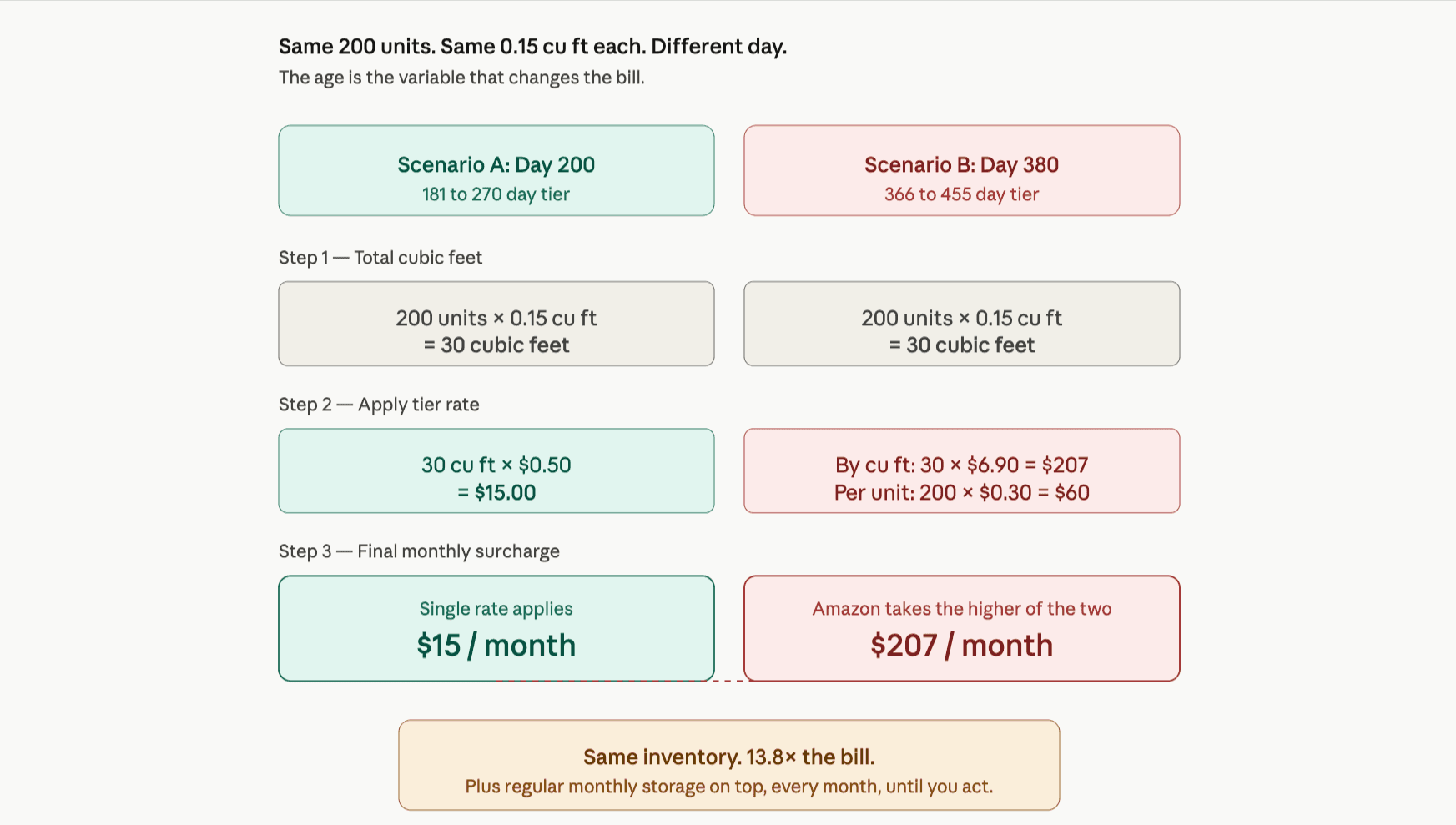
You have 200 units of a product that's been in FBA for 200 days. Each unit is 0.15 cubic feet.
You're in the 181 to 270 day tier, so the rate is $0.50 per cubic foot.
200 units × 0.15 cubic feet = 30 cubic feet.
30 × $0.50 = $15 surcharge for the month.
Not bad. Now let the same inventory sit for another six months untouched.
Now you're at 380 days. You've moved into the 366 to 455 day tier at $6.90 per cubic foot, or $0.30 per unit, whichever is greater.
By cubic feet: 30 × $6.90 = $207. Per unit: 200 × $0.30 = $60.
Amazon charges the higher of the two. That's $207 per month, every month, until you do something about it. Plus your regular monthly storage on the same units.
This is why people say the surcharge "compounds." It doesn't really. But the rate keeps climbing as the inventory ages, so the bill goes up even if the unit count doesn't change.
How the assessment date catches people
The 15th-of-the-month thing is genuinely important. Most sellers don't know about it.
If you submit a removal order by the 14th, the units come off the snapshot. Even if the physical removal takes weeks to actually process, the surcharge stops accruing for the month.
If you submit on the 16th, you've just paid another full month of fees on inventory you were already trying to remove.
Pull your Inventory Age Report a week before the 15th. Set a recurring calendar reminder. This one habit saves real money.
Show Image
Where to find your numbers
Two reports inside Seller Central tell you everything you need.
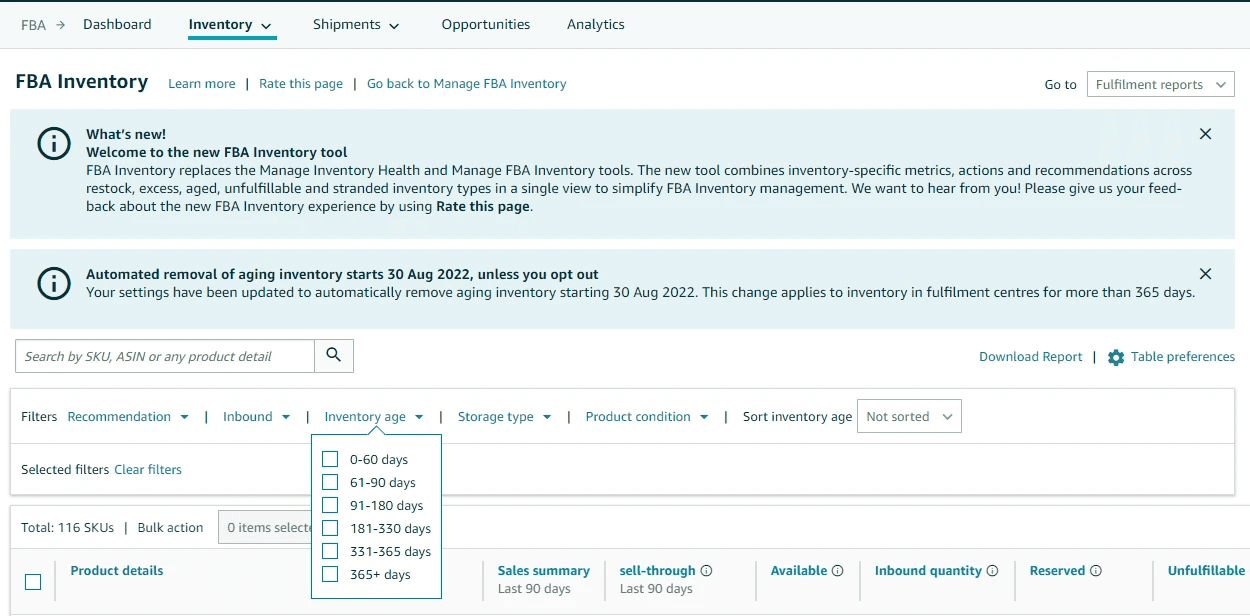
FBA Inventory Age Report. Shows every SKU and how long each unit has been in FBA. Sort by age, descending. Anything past 150 days is a unit you need to make a decision on this month.
Aged Inventory Surcharge Report. Shows the surcharge already applied or projected for each SKU. This is the report to pull right before the 15th to see what's about to be billed.
Both live under Reports → Fulfillment in Seller Central. The FBA Inventory tool also has a forward-looking view that shows which SKUs will hit the next tier in the next 60 days.
That last view is gold. If a SKU is at day 250 and selling slowly, you have about three weeks before it crosses into the much steeper 271+ tier.
Why 181 days is the deadline that actually matters
The old 271-day or 365-day thresholds let you procrastinate. The new 181-day cutoff doesn't.
For most products with a 60 to 90 day lead time, here's what the math looks like:
Day 0: inventory lands at FBA.
Day 181: surcharge clock starts. About six months of selling time before that point.
If your sell-through isn't fast enough to clear most of a shipment in six months, you're going to pay the surcharge on whatever's left. And you'll keep paying it, escalating, until the inventory moves or you remove it.
This is why the conversation about FBA inventory shifted from "how much can we send in?" to "how lean can we run without stocking out?"
Your options when inventory is approaching the cliff
Three real options. Plus one bad one.
Run a promotion. Drop the price, run a coupon, push it through Amazon Outlet (which requires at least a 20% discount). Works best if you have margin to spare and the product can move at a discount without damaging your brand.
Remove the inventory. Send it back to your own warehouse or a 3PL. There's a removal fee per unit, but if you can sell the units off-Amazon or rework them into bundles, this is often cheaper than paying surcharges for another six months.
Liquidate through Amazon's program. Amazon partners with liquidators and pays you 5 to 10% of the average selling price. Fast and easy, but the recovery is low. Use it as a last resort, not a first move.
The bad option is doing nothing and hoping the inventory sells. It usually doesn't, and the bill keeps climbing every month.
Run the numbers on each option with your actual unit cost and your actual surcharge exposure. Sometimes liquidation at 8% recovery beats paying $200 a month in surcharges for the next year.
What to do this week
Open the FBA Inventory Age Report.
Filter for anything over 150 days. These are the units about to start accruing the surcharge if they aren't already.
For each SKU on that list, decide: promote, remove, or liquidate. Make the call this week, before the 15th of next month.
Then look at anything in the 100 to 150 day range. Forecast forward. If sell-through over the past 30 days won't clear those units before day 181, you have a problem to solve now, not later.
Set a recurring calendar reminder for the 10th of every month to do this audit. It's a 30-minute task that protects real margin.
Show Image
The bigger pattern
The 181-day threshold isn't isolated. It's part of a broader push from Amazon to keep their fulfillment centers running lean and turning inventory fast.
The fuel and logistics surcharge that went live April 17, 2026 adds 3.5% to every fulfillment fee. The low-inventory-level fee is now calculated per FNSKU instead of per parent ASIN, so a single stocked-out variation triggers fees even when the rest of the SKU family is healthy. Storage utilization surcharges hit harder if you over-stock relative to recent demand.
Add it all up and the safe operating zone is narrower than it used to be. Most brands now run 30 to 45 days of safety stock, down from 45 to 60 a year or two ago. Smaller, more frequent shipments. AWD or a 3PL holding the buffer. FBA holding only what's selling now.
It's more operationally demanding, but the brands that adjusted early are paying meaningfully less in surcharges than the ones still running 2024-era playbooks.
Quick FAQ
When does Amazon charge the surcharge? Once a month, based on an inventory snapshot taken on the 15th. Removal orders submitted before the 14th stop the fee for that month.
Does the surcharge replace the monthly storage fee?
No. It's stacked on top. A 200-day-old unit pays both regular monthly storage and the 181 to 270 day surcharge.
What's the difference between this and the Storage Utilization Surcharge?
The Aged Inventory Surcharge is about how long inventory has been there. The Storage Utilization Surcharge is about how much you've sent in relative to recent sell-through. Different problem, different fee, charged separately.
Can I get the surcharge waived?
Generally no. Amazon doesn't have a standard waiver process. The only way to avoid it is to move the inventory out before the assessment date.
Are clothing and accessories really exempt from the early tiers?
For the 181 to 270 day tier specifically, yes. Apparel, footwear, bags, jewelry, and watches get a longer runway before the surcharge starts. They still get hit at the later tiers.