How to manage Amazon Vendor chargebacks (2026)

Nishant Singh
Amazon vendor chargebacks can quietly reduce margins without clear visibility. A missing label, late ASN, or packaging mismatch is often enough for Amazon to issue a chargeback.
For many vendors, chargebacks feel unpredictable and difficult to dispute. They usually appear after delivery, with limited explanation, and can repeat across multiple POs if the root cause isn’t addressed.
Over time, these deductions add up and turn small operational issues into ongoing revenue loss.
In this guide, we’ll explain what Amazon vendor chargebacks are, why they happen, and how vendors can identify, prevent, and dispute them to protect margins.
What Are Amazon Vendor Chargebacks?
Amazon vendor chargebacks are fees Amazon deducts from a vendor’s invoice when a shipment does not meet Vendor Central compliance requirements. These chargebacks are typically applied for operational issues such as labeling errors, packaging mismatches, late shipments, or incomplete documentation.
Chargebacks usually appear after Amazon receives the shipment, not at the time the issue occurs. This makes them easy to miss, especially for vendors managing high PO volumes. In many cases, the products are still received and sold, but Amazon deducts a fee to cover the extra handling or corrective work required.
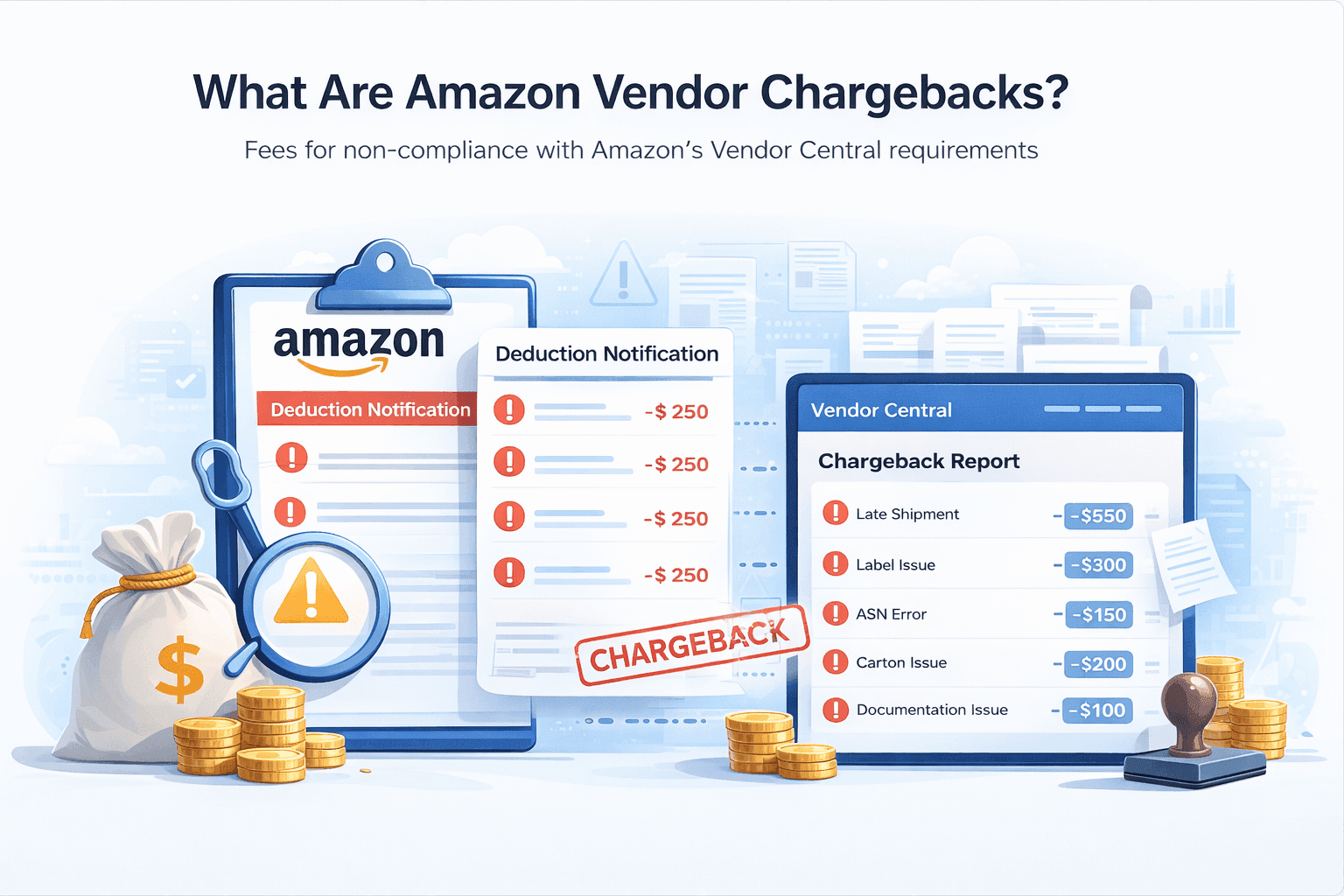
For example, if a purchase order requires specific carton labels and they are missing or incorrect, Amazon may apply a chargeback even though the inventory is accepted into the fulfillment network. The same applies to late ASNs, incorrect quantities, or packaging that does not match Amazon’s routing or prep requirements.
Vendor chargebacks are part of Amazon’s compliance and cost-recovery system. While some are valid, others result from system mismatches, timing issues, or unclear requirements. Understanding how chargebacks work is the first step toward reducing unnecessary deductions and improving operational efficiency in Vendor Central.
Common Types of Amazon Vendor Chargebacks
Amazon vendor chargebacks usually fall into a few repeatable categories. Understanding these common types makes it easier to identify patterns, fix root causes, and reduce future deductions.
1. Labeling Chargebacks
Labeling issues are one of the most frequent causes of vendor chargebacks. These occur when carton labels, pallet labels, or item labels are missing, incorrect, or not scannable.
Common triggers include:
Missing GS1-128 or carton labels
Incorrect label placement
Labels that do not match the purchase order
Even if the shipment is received, Amazon may charge back for the extra labor required to relabel inventory.
2. ASN (Advance Shipment Notice) Chargebacks
ASN chargebacks happen when shipment data is missing, late, or inaccurate. Amazon relies on ASNs to plan receiving and labor, so errors here often result in penalties.
Typical issues include:
ASN submitted late
Incorrect quantities in the ASN
ASN not matching the actual shipment
These chargebacks are common and often repeat if processes are not automated.
3. Packaging and Prep Chargebacks
Amazon has strict packaging and prep requirements. Chargebacks occur when shipments do not follow these standards and require manual correction.
Examples include:
Incorrect carton size or weight
Improper pallet configuration
Missing poly bags or protective packaging
These issues slow down receiving and increase handling costs, which Amazon passes back to vendors.
4. Routing and Carrier Compliance Chargebacks
Routing-related chargebacks occur when shipments do not follow Amazon’s routing instructions.
This can happen when:
An unauthorized carrier is used
Shipments are sent to the wrong fulfillment center
Appointments are missed or booked incorrectly
These chargebacks are common in high-volume freight operations.
5. Quantity and PO Compliance Chargebacks
Amazon expects shipments to closely match the purchase order.
Chargebacks may be applied when:
Overages or shortages exceed allowed thresholds
Mixed SKUs are packed incorrectly
Case pack quantities do not match PO requirements
Even small quantity mismatches can trigger repeated chargebacks.
6. Documentation and Timing Chargebacks
Some chargebacks are related to missing or incorrect paperwork.
Examples include:
Missing packing lists
Incorrect invoice details
Late shipment confirmations
These issues often occur due to manual workflows or disconnected systems.
When to Dispute a Chargeback
Not every chargeback should be disputed. The goal is to focus on cases where Amazon’s deduction does not align with what actually happened on the shipment or PO.
You should consider disputing a chargeback when:
You followed Amazon’s routing, labeling, and packaging instructions exactly
Documentation was submitted on time and correctly
The chargeback reason does not match the actual issue
The same chargeback appears repeatedly despite corrective actions
Disputing selectively improves success rates and avoids wasting time on cases that are unlikely to be overturned.
Valid Grounds for Disputing Chargebacks
Focus your dispute efforts on chargebacks with clear documentation supporting your position:
Dispute Category | Success Rate | Required Evidence | Timeline |
|---|---|---|---|
Documentation Errors | 75-85% | Original shipping docs, receipts | 30 days |
Policy Misinterpretation | 60-70% | Vendor agreement clauses, precedent | 45 days |
System Glitches | 80-90% | Screenshots, timestamps, logs | 15 days |
Duplicate Charges | 95%+ | Payment records, invoice history | 30 days |
Documentation Errors represent your strongest dispute category. When Amazon's automated systems misread shipping labels, product codes, or invoice details, you can usually provide clear evidence proving the error.
Policy Misinterpretations occur when Amazon applies chargeback rules incorrectly or uses outdated policy versions. These require more detailed arguments, but often succeed when you can cite specific vendor agreement language.
Chargebacks You Shouldn’t Contest
Not all chargebacks are worth fighting. Disputing weak cases often leads to automatic denials and wasted effort.
You should generally avoid disputing chargebacks when:
Labels, ASNs, or packaging were genuinely incorrect
The shipment was late or routed incorrectly
Required documentation was missing or incomplete
The chargeback amount is very small and recurring issues are already fixed
In these cases, it’s usually better to fix the root cause and prevent future chargebacks rather than dispute the current one.
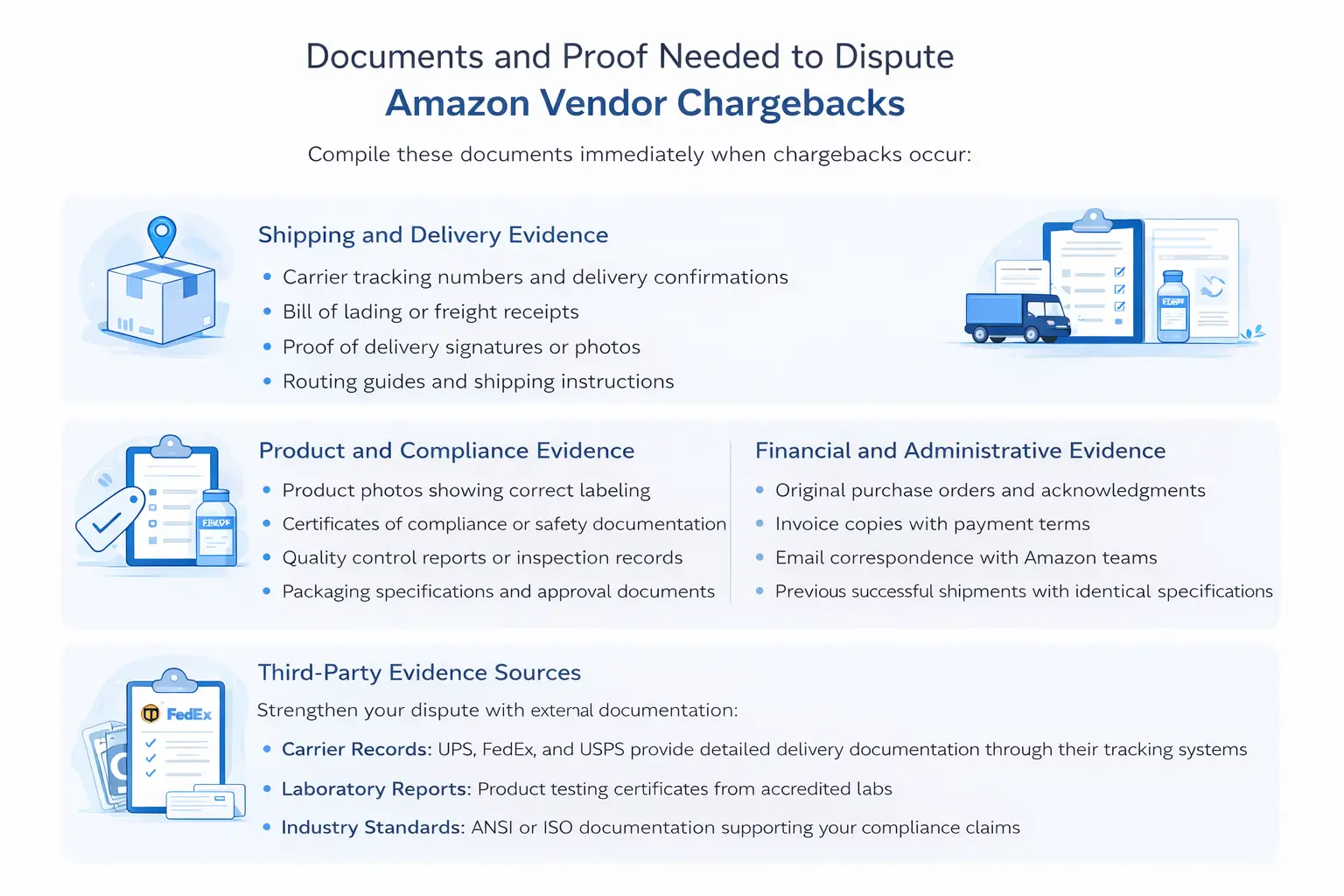
Documents and Proof Needed to Dispute Amazon Vendor Chargebacks
Compile these documents immediately when chargebacks occur:
Shipping and Delivery Evidence:
Carrier tracking numbers and delivery confirmations
Bill of lading or freight receipts
Proof of delivery signatures or photos
Routing guides and shipping instructions
Product and Compliance Evidence:
Product photos showing correct labeling
Certificates of compliance or safety documentation
Quality control reports or inspection records
Packaging specifications and approval documents
Financial and Administrative Evidence:
Original purchase orders and acknowledgments
Invoice copies with payment terms
Email correspondence with Amazon teams
Previous successful shipments with identical specifications
Third-Party Evidence Sources
Strengthen your dispute with external documentation:
Carrier Records: UPS, FedEx, and USPS provide detailed delivery documentation through their tracking systems
Laboratory Reports: Product testing certificates from accredited labs
Industry Standards: ANSI or ISO documentation supporting your compliance claims
Supplier Documentation: Certificates from manufacturers proving product specifications
How to Dispute Amazon Vendor Chargebacks
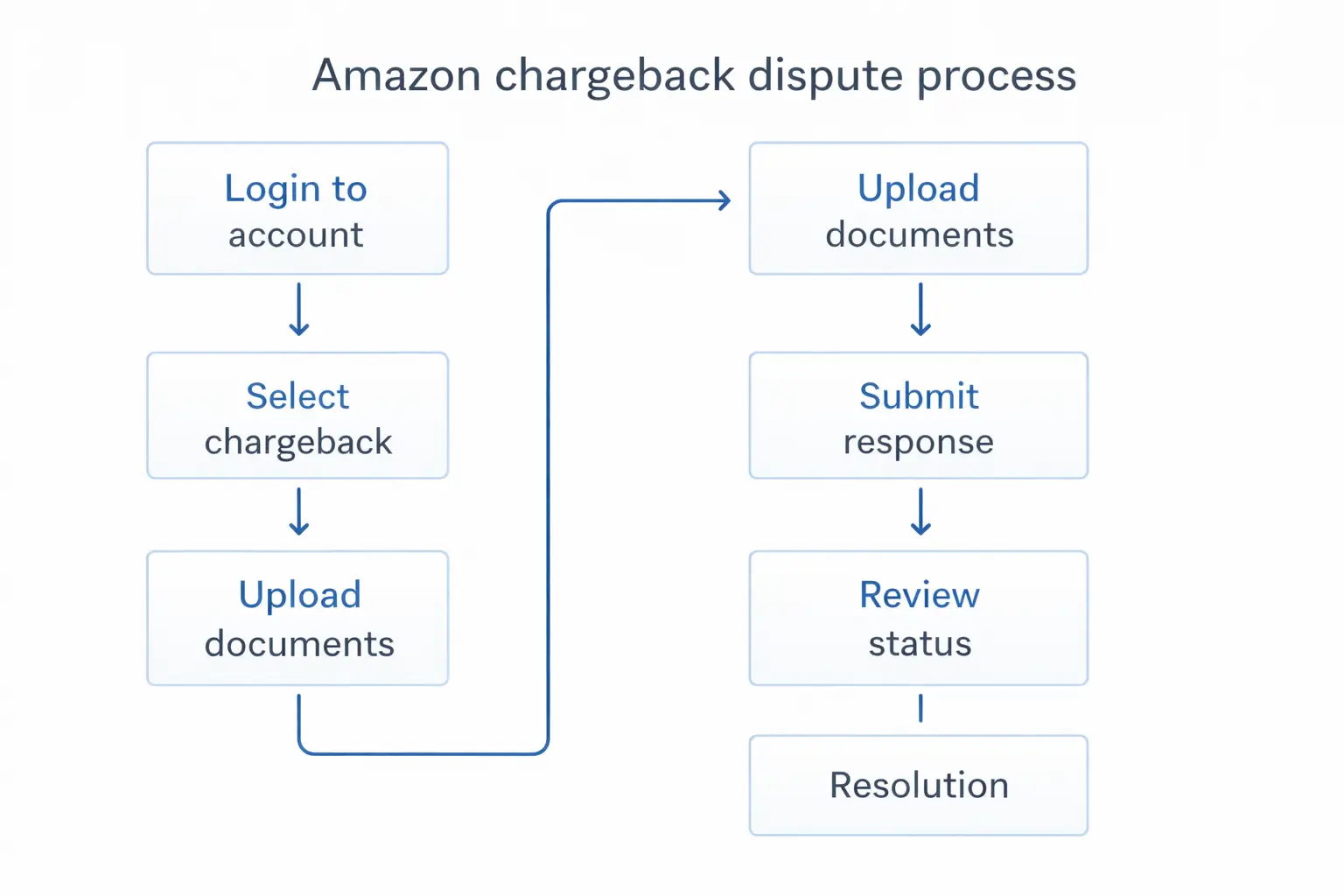
Disputing Amazon vendor chargebacks can feel daunting, but a straightforward process can make it manageable. Here are the steps to follow to dispute a chargeback effectively:
1. Review the Chargeback Details
Start by logging into Vendor Central and navigating to the Operational Performance dashboard. Here, you’ll find a list of chargebacks. Click on the chargeback in question to review the specific reason, the PO number, and the amount deducted.
2. Verify Compliance on Your End
Check your own records to confirm whether the chargeback is valid or a mistake. Look at the shipment details, ASN submission times, labeling accuracy, and carrier documentation. If everything was done according to Amazon’s requirements, you have a strong case for a dispute.
3. Gather Supporting Evidence
Prepare all necessary documentation to support your dispute. This may include proof of correct labeling, screenshots of on-time ASN submissions, carrier confirmations, and any internal records showing compliance.
4. Submit the Dispute in Vendor Central
Once you have your evidence, go back to the chargeback in Vendor Central. Use the Dispute button to submit your case, providing a clear, concise explanation of why you believe the chargeback is invalid. Attach all supporting documents.
5. Monitor the Dispute Status
After submission, keep an eye on the status of your dispute. You can check this in the Operational Performance dashboard. Amazon will typically mark the dispute as approved, pending, or rejected. If approved, you should see the funds returned in the next payment cycle.
Following Up on Your Dispute
Amazon provides dispute status updates through Vendor Central, but proactive follow-up improves resolution speed. Check your dispute status weekly and respond promptly to any requests for additional information.
If you don't receive an initial acknowledgment within 5 business days, contact Vendor Support to confirm receipt. Document all follow-up communications for potential escalation needs.
Writing Effective Dispute Arguments
Your written argument serves as the foundation for Amazon's review decision. Clear, factual arguments supported by specific evidence achieve significantly higher success rates than emotional appeals or general denials.
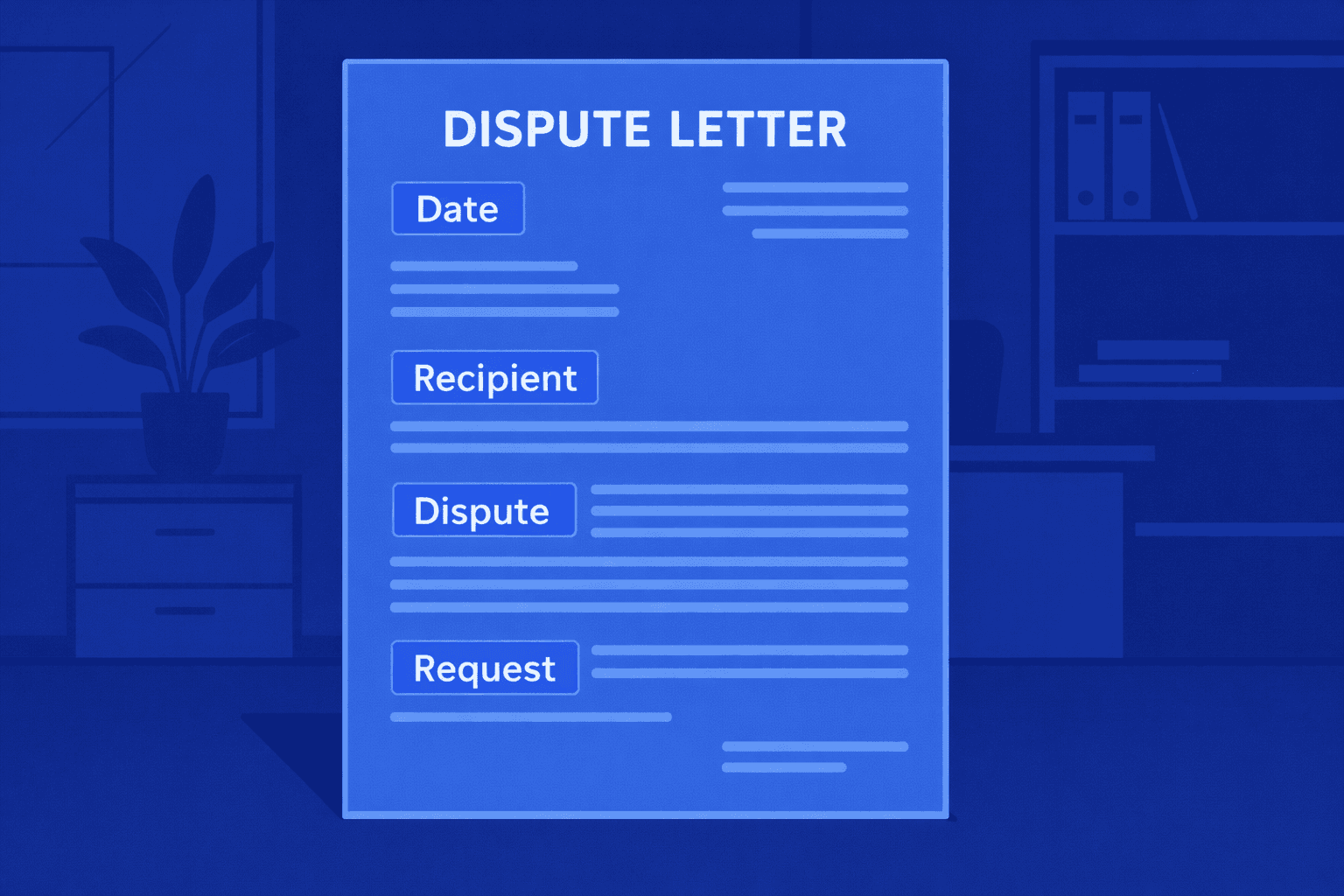
Structure of a Winning Dispute Letter
Follow this proven structure for maximum impact:
Opening Paragraph: State the dispute purpose, reference specific chargeback details, and summarize your position in 2-3 sentences.
Evidence Section: Present facts chronologically with specific document references. Use bullet points for complex issues:
Document A shows delivery occurred on [date]
Document B confirms compliance with requirement X
Document C demonstrates proper labeling per vendor agreement section Y
Policy Reference Section: Cite specific vendor agreement clauses or Amazon policies supporting your position. Include exact quote text and section numbers.
Conclusion: Restate your request for chargeback reversal and reference the strongest piece of supporting evidence.
Templates and Examples
Here's a template for documentation error disputes:
"This dispute addresses chargeback [reference number] dated [date] for $[amount] related to [violation type]. Our review of shipping documentation reveals an error in Amazon's assessment.
Evidence provided demonstrates: • Delivery confirmation shows arrival on [date] at [time], meeting the required [deadline] • Bill of lading [number] confirms proper routing per Amazon's instructions • Carrier tracking [number] provides complete delivery chain documentation
Per vendor agreement section [X.Y], deliveries meeting the specified timeline should not incur chargebacks. The attached documentation clearly establishes compliance with all delivery requirements.
Request: Please reverse chargeback [reference number] and credit our account $[amount] based on the provided delivery confirmation evidence."
Amazon's Dispute Review Process
Understanding Amazon's internal review process helps you optimize your dispute strategy and set realistic expectations for resolution timelines.
Timeline Expectations
Amazon's dispute review follows a structured timeline:
Initial Review: 5-10 business days for dispute acknowledgment
Evidence Review: 15-30 business days for thorough documentation analysis
Decision Communication: 3-5 business days after review completion
Credit Processing: 5-7 business days for approved disputes
Complex disputes involving policy interpretation or multiple violations may extend beyond standard timelines.
Advanced Dispute Strategies
For high-value disputes or complex policy issues, advanced strategies can improve success rates and resolution speed.
Working with Amazon Vendor Support
Leverage your vendor support relationship for dispute assistance:
Schedule pre-dispute consultations for complex compliance questions
Request policy clarification before implementing new processes
Use vendor support as intermediaries for high-value dispute escalations
Document all vendor support interactions for future reference
Strong vendor relationships can provide insights into Amazon's interpretation of ambiguous policy language and help you avoid future disputes.
When to Involve Legal Counsel
Consider legal assistance for:
Disputes exceeding $10,000 in total value
Systematic chargeback patterns affecting multiple product lines
Policy interpretations with significant future financial impact
Vendor agreement disputes requiring contract analysis
The American Bar Association maintains directories of attorneys specializing in commercial dispute resolution and contract interpretation.
Pattern Recognition for Systematic Issues
Analyze chargeback data to identify systematic problems:
Pattern Type | Indicators | Solution Strategy | Prevention Method |
|---|---|---|---|
Seasonal Spikes | Chargebacks increase during peak periods | Capacity planning, early shipping | Seasonal staffing, extended deadlines |
Product-Specific | Certain ASINs generate repeated violations | Product redesign, enhanced testing | Quality control improvements |
Geographic Patterns | Regional distribution centers show issues | Routing optimization, carrier changes | Regional compliance training |
Process Failures | Similar violations across product lines | Systematic process review | Standard operating procedures |
Conclusion
Amazon vendor chargebacks are a common part of operating as a 1P vendor, but they do not have to be accepted without review. Many chargebacks result from data mismatches, timing issues, or system errors rather than true non-compliance.
The key to successful disputes is a structured approach. Reviewing chargeback details carefully, validating compliance internally, and submitting clear evidence through Vendor Central significantly improves the chances of recovery. Just as important is knowing when not to dispute and instead focus on fixing the underlying operational issue.
Regularly monitoring chargebacks and dispute outcomes helps vendors spot repeat patterns and prevent the same issues from happening across future purchase orders. Over time, this reduces revenue leakage and makes chargeback management more predictable.
With the right process in place, chargebacks become less of a surprise and more of a manageable part of running a compliant and profitable Amazon Vendor Central operation.
Frequently Asked Questions on Disputing Amazon Vendor Chargebacks
1. How long do vendors have to dispute an Amazon chargeback?
In most cases, vendors have 30 days from the chargeback notification date to submit a dispute. Some chargeback types may allow a second dispute within a limited window after the first rejection. If the dispute window is missed, Amazon usually closes the case with no option to appeal.
2. Where do I submit a dispute for an Amazon vendor chargeback?
Chargeback disputes are submitted directly in Vendor Central, typically through the Operational Performance or Chargeback dashboard. From there, vendors can select the chargeback, click Dispute, and upload supporting documentation.
3. What documentation is required to dispute a chargeback?
Required documentation depends on the chargeback type, but commonly includes:
Bill of Lading (BOL) or Proof of Delivery (POD)
ASN submission records
Carton or pallet label samples
Packing lists or invoices
Screenshots or reports from Vendor Central
Clear, well-organized documentation that directly supports the dispute reason significantly improves approval chances.
4. Why was my chargeback dispute rejected even though I provided evidence?
Disputes are often rejected when documentation does not exactly match Amazon’s records. Common issues include mismatched PO numbers, incorrect unit counts, missing dates, or unclear files. Always review Amazon’s rejection comments carefully and correct any discrepancies before resubmitting, if another dispute attempt is allowed.
5. Can vendors dispute multiple chargebacks at once?
Yes. Vendor Central allows vendors to dispute multiple chargebacks individually or in batches. However, each chargeback must be supported with its own relevant documentation, even when submitted together.
6. Are all Amazon vendor chargebacks worth disputing?
No. Chargebacks caused by genuine non-compliance, such as late shipments or incorrect labeling, are unlikely to be reversed. Disputes are most successful when the chargeback is due to data mismatches, system errors, or incorrect application of Amazon’s rules.
7. How long does Amazon take to review a chargeback dispute?
Review times vary, but most disputes are resolved within a few days to several weeks. During this time, the dispute status will appear as pending, approved, or rejected in Vendor Central.