Amazon DSP Deals: A Complete Guide to Deal Types & Deal IDs

Karina Singhal
Most programmatic ads are bought in the open auction, where every advertiser bids on the same inventory and the highest bid wins. It works, but you give up a lot of control over where your ads land and what you pay. Amazon DSP Deals are the alternative. They let you lock in premium inventory, pricing, and placements ahead of time, before the auction even starts.
This guide covers what Amazon DSP Deals are, the three deal types you can run, what a Deal ID does, how to activate a deal, and how to choose the right type for your campaign. We will also get into the best practices that decide whether a deal actually performs.
First, what is Amazon DSP?
Before deals make sense, it helps to be clear on the platform underneath them.
Amazon DSP (Demand Side Platform) is Amazon's programmatic advertising product. It lets you buy video, display, audio, and Connected TV (CTV) ads both on and off Amazon. That last part is the important distinction. Sponsored Products and Sponsored Brands show up inside Amazon search results. Amazon DSP reaches people well beyond the search bar.
With DSP, your ads can run across:
Amazon-owned properties like Prime Video, Twitch, Fire TV, IMDb, and Amazon.com
Third-party apps and websites
Premium streaming inventory
External publishers and ad exchanges
What makes Amazon DSP different from a generic DSP is the signal behind it. Amazon layers in its own first-party shopping, browsing, and streaming data, so you can reach audiences based on what they actually buy and watch, not just a third-party guess. If you want to go deeper on how that targeting works, our guide to Amazon DSP targeting options walks through all of them. For the official source, Amazon's own Amazon DSP overview covers the platform basics.
Deals are how you decide where and under what terms all of that targeting gets applied.
What are Amazon DSP Deals?
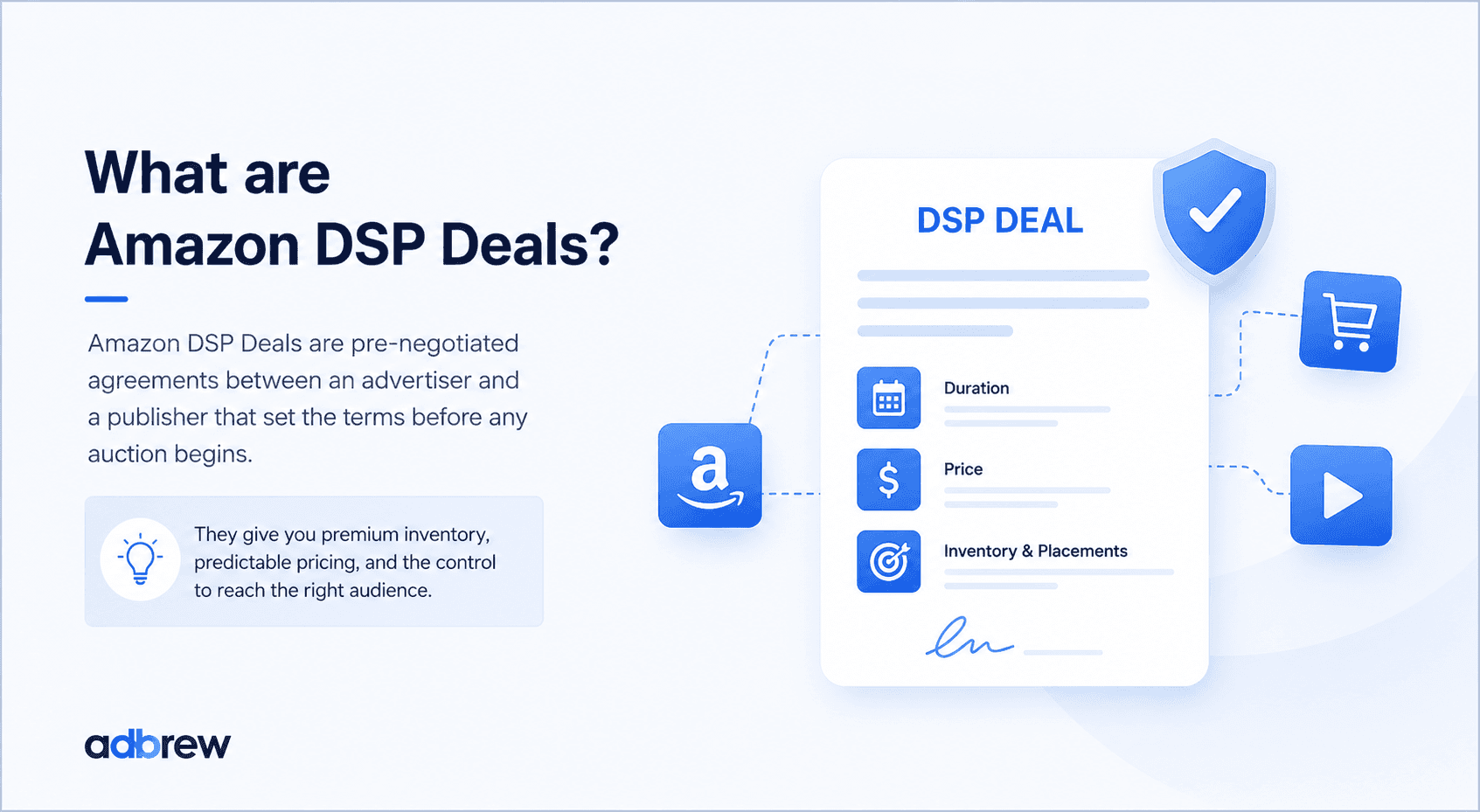
Amazon DSP Deals are pre-negotiated agreements between an advertiser and a publisher. The deal sets the terms (duration, price, access, and inventory availability) before any campaign enters an auction.
A simple way to hold the difference in your head:
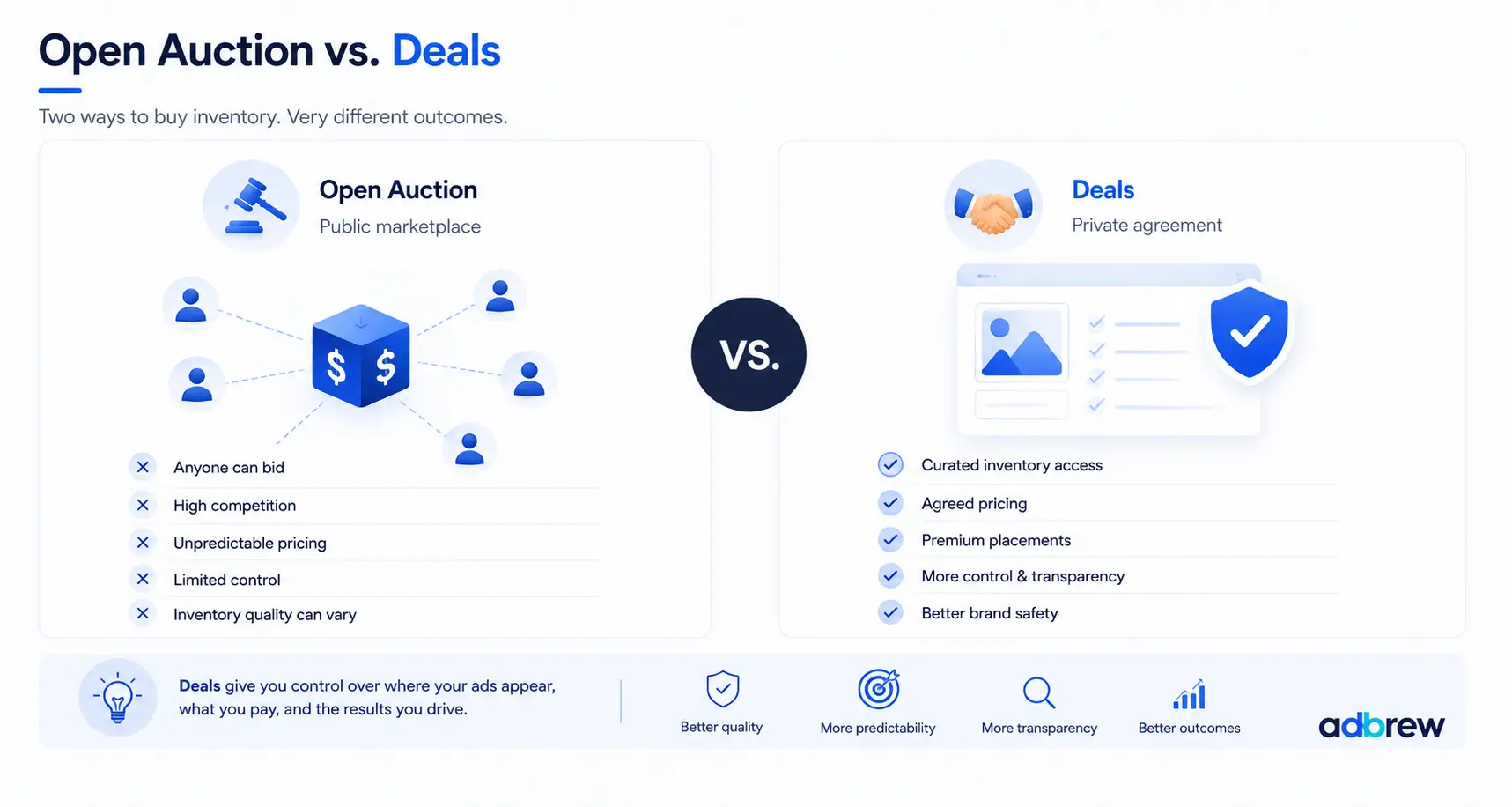
An open auction is a public marketplace. Anyone can bid, competition is high, and you take whatever you win at whatever price the auction lands on.
A deal is closer to a reserved table. The inventory is curated, the pricing is agreed in advance, and you are not elbowing every other advertiser to get it.
That trade is the whole point. Instead of competing for scraps in the open exchange, brands buying through deals get access to premium placements, cleaner inventory, and higher-quality audiences.
Deals tend to earn their keep for advertisers running:
Brand awareness campaigns
Premium video and streaming TV ads
Seasonal launches
Large-scale retargeting
High-budget branding pushes
In one example, the team at Adbrew helped a skincare brand launch a premium product using deals on beauty-publisher inventory inside a Private Marketplace, rather than leaning entirely on open-exchange traffic. The result was tighter control over context and a better fit between the product and the audience seeing it.
Why advertisers use Amazon DSP Deals
Control is the short answer, but it is worth unpacking what that control actually buys you. Deals give you:
Premium inventory access. Placements that are not always available, or not affordable, in the open auction.
Higher viewability. Curated inventory tends to put your ad where people can actually see it.
Better brand safety. You know which publishers you are running with, which matters when context can make or break a premium product.
More transparency. You can see and choose where your spend is going.
Predictable cost and delivery. Negotiated pricing means fewer surprises when the invoice arrives.
The three types of Amazon DSP Deals
There are three deal structures you can activate through Amazon DSP. They differ on price, guarantees, competition, and flexibility, so the right one depends on what the campaign needs.
1. Programmatic Guaranteed (PG) Deals
A Programmatic Guaranteed deal is a one-to-one agreement where the publisher guarantees a set amount of inventory at a fixed, negotiated price. The agreement can spell out campaign duration, guaranteed impressions, and targeting specifics like geography or audience.
This is the most locked-down option. There is no auction and no competition, which means there are also no surprises. You know what you are getting and what it costs.
When it fits: a D2C electronics brand reserving premium ad inventory on Prime Video ahead of a high-traffic window like Prime Day or Black Friday / Cyber Monday. When you cannot afford to miss the moment, a guarantee is worth paying for.
2. Preferred Deals
A Preferred Deal is also one-to-one, but instead of guaranteeing volume, the publisher offers you first look at inventory at a fixed price before that inventory goes to the open auction. You are not obligated to buy every impression. You pay only when an impression meets your targeting criteria.
That makes Preferred Deals more flexible than PG. You get priority access and a known price, without committing to a fixed volume.
When it fits: a brand that wants to retarget past site visitors, but only when those visitors are browsing a premium fashion publisher. The Preferred Deal gives first-look access to that publisher's inventory, and the brand only pays when the targeting matches.
3. Private Auction
Amazon's term for this is a Private Auction (PA). In the wider industry you will often hear it grouped under the umbrella term Private Marketplace (PMP), and the two get used interchangeably, so it helps to know both.
A Private Auction is an invite-only auction. Unlike the open auction, only a selected group of advertisers can participate. The publisher offers curated premium inventory at a negotiated floor price, and the invited advertisers compete from there. Because there is real bidding, the CPM is variable rather than fixed, which is the key difference from a Preferred Deal: the floor sets the bottom, but competition decides the final price.
So you still get the competitive dynamic of an auction, but inside a walled garden of vetted buyers and premium supply. That price flexibility is why some performance-focused buyers favor Private Auctions on premium video, where fixed-CPM deals can price them out.
When it fits: a premium live-sports streaming partner that wants to make its inventory available only to premium sportswear brands. The auction stays competitive, but the guest list keeps the quality high.
Programmatic Guaranteed vs Preferred Deals vs Private Auction
Feature | Programmatic Guaranteed | Preferred Deals | PMP / Private Auction |
|---|---|---|---|
Pricing | Fixed CPM | Fixed CPM | Auction-based |
Inventory access | Inventory is reserved | First-look access | Invite-only auction |
Guaranteed delivery | Yes | No | No |
Competition | None | Low | Moderate |
Flexibility | Low | High | Medium |
Deal structure | One-to-one | One-to-one | One-to-few |
Inventory type | Premium | Premium (before others access it) | Premium |
Recommended for | Large awareness campaigns | Flexible premium buying | Controlled auctions |
A useful way to read this table: PG trades flexibility for certainty, Preferred Deals trade certainty for flexibility, and Private Auctions sit in the middle, giving you premium supply with some competitive price discovery still in play.
What is a Deal ID in Amazon DSP?
A Deal ID is the unique code that ties an advertiser to a specific block of publisher inventory inside Amazon DSP.
The flow is straightforward. The publisher (or its SSP / ad server) generates the Deal ID, usually a string of around 19 characters, and shares it with the advertiser. The advertiser adds that ID to their DSP line item, and that single identifier unlocks the negotiated placements, pricing, and terms. Under the hood, the Deal ID travels along with the bid request, so the DSP recognizes the deal and bids according to the agreed terms rather than treating it as open inventory. Think of it as a key cut for one lock. It tells the system exactly which inventory you have access to and on what terms, which is what gives you the control and transparency that deals are known for.
How to activate a deal in Amazon DSP
The activation process itself is simple. What changes is where the deal originates: Amazon, or a third party.
Worth knowing before you start: Amazon now offers a single Deals widget inside DSP, so you can discover and activate all three deal types (Preferred, Private Auction, and Programmatic Guaranteed) from one place when you build or edit a line item. Amazon has also opened up self-serve creation of Preferred and Programmatic Guaranteed deals with its own Amazon Media publishers, including Prime Video and Twitch.
You can propose a deal, pick contextual targeting and budget, and proposals are typically reviewed within minutes before going live. That self-serve path has been rolling out across the US, Canada, Mexico, and several European markets.
1. Amazon Publisher Direct (APD) Deals
APD Deals are ready-to-use packages that Amazon creates and manages itself. You do not have to coordinate with an outside publisher, because Amazon already holds this inventory inside DSP. You activate the package directly from the inventory section, and once it is on, it shows up automatically in your campaign setup. This is the quickest path when you want premium publisher inventory without negotiating anything by hand.
2. Third-Party Exchange Deals
This is the most common setup for advertisers working with premium publishers outside Amazon. Here you coordinate with the publisher, an SSP (Supply Side Platform), or a media partner. The publisher hands you a Deal ID, and you add it to your line item inside Amazon DSP.
One detail to watch: some exchanges, like Google Ad Manager, require you to manually approve the deal before it goes live in DSP. Other SSPs sync automatically once the deal is created.
3. Amazon-Created Deals
Amazon also builds prebuilt deal packages internally, drawing on both Amazon Publisher Direct and third-party supply. These are essentially plug-and-play. Unlike PMP deals, they are not negotiated with you individually. Amazon assembles them by inventory type, audience, or publisher category, and you simply pick the package that fits and activate it. For a lot of brands, this is the lowest-friction way to start testing premium inventory inside DSP.
When should you actually use deals?
Deals are not automatically the right call for every campaign. Open auctions still win on scale, reach, and pure flexibility, and they are usually cheaper per impression. So the question is less "are deals better" and more "what is this campaign trying to do."
Reach for a deal when:
You are running upper-funnel branding. Awareness and video campaigns benefit from premium context and high viewability, which is exactly what deals deliver.
Context matters as much as the audience. A luxury or premium product often needs to sit next to the right content, not just in front of the right person.
You need delivery certainty. For a tentpole moment like a product launch or Prime Day, a Programmatic Guaranteed deal protects you from getting outbid at the worst possible time.
You want cleaner, more transparent supply. If brand safety and viewability are non-negotiable, curated inventory does the heavy lifting.
Stay in the open auction when you are chasing broad scale at the lowest cost, testing into new audiences, or running performance campaigns where flexibility beats certainty. In practice, most mature DSP programs run both, using deals for the placements that have to be right and the open exchange for everything that just has to be efficient.
Best practices to get more from your DSP Deals
Activating a deal is the easy part. Getting it to perform takes a bit more discipline, and it helps to know the common DSP mistakes that quietly drain budgets before you spend on premium inventory.
Match the deal type to the goal before you negotiate.
Do not lock into a Programmatic Guaranteed commitment for a campaign that needs room to flex. Decide whether you are buying certainty, first-look access, or curated competition, then pick the structure that matches.
Negotiate on more than CPM.
Price matters, but so do viewability standards, share of voice, frequency caps, and the specific placements included. A slightly higher CPM on inventory that actually gets seen beats a cheap deal that buries your ad below the fold.
Layer your own audiences on top of the deal.
A deal defines the supply, not the targeting. Combine it with Amazon's first-party shopping and streaming signals so you are reaching the right people and in the right place.
Set realistic frequency caps.
Premium inventory plus a high-budget branding push can hammer the same viewers repeatedly. Cap frequency so you build reach instead of annoyance, and consider excluding audiences who have already converted or repeatedly ignored your ads to keep that spend working.
Watch delivery early and often.
Preferred Deals and Private Auctions do not guarantee volume, so check pacing in the first few days. If a Preferred Deal is under-delivering, you may need to widen targeting or revisit the floor price with the publisher.
Keep your creative aligned with the placement.
Premium streaming and CTV inventory expects premium creative. Reusing a static display unit on high-end video supply wastes the placement you paid extra to get.
Measure incrementality, not just last-click.
Deals shine in upper-funnel and awareness work, where the value shows up in new-to-brand reach and downstream conversions rather than immediate clicks. Judge them on the right yardstick. This is also where Amazon Marketing Cloud (AMC) becomes useful, since it lets you connect upper-funnel deal exposure to eventual purchases. If you are setting up measurement, our walkthrough on reading Amazon DSP reports covers which metrics actually matter.
Final thoughts
Amazon DSP Deals give advertisers a more controlled, more premium way to buy programmatic inventory. Instead of living entirely in the open auction, you get access to premium publishers, guaranteed or first-look inventory, and stronger audience quality.
If your goal is to lift the quality of your inventory, tighten your targeting, and build awareness at scale, the move is to understand the three deal types and use each one where it is strongest. Programmatic Guaranteed for certainty, Preferred Deals for flexible first-look access, and Private Auctions for curated competition. Get that match right, layer your audiences and creative on top, and a deal stops being a line item and starts being a lever.
If you want help putting deals to work without managing every line item by hand, see how Adbrew's Amazon DSP platform helps brands and agencies run, optimize, and report on DSP campaigns from one place, with no minimum spend to get started.
FAQs
What are Deals in Amazon DSP?
Amazon DSP Deals are pre-negotiated agreements between advertisers and publishers that give controlled access to premium inventory, pricing, and targeting, settled before a campaign enters the auction.
What is a Deal ID in Amazon DSP?
A Deal ID is a unique identifier a publisher shares with an advertiser. Added to a DSP campaign, it unlocks a specific block of inventory at the negotiated terms.
What is the difference between Private Auction (PMP) and Preferred Deals?
Preferred Deals give one advertiser first-look access at a fixed CPM. A Private Auction, which Amazon labels as such and the industry often files under the PMP umbrella, is an invite-only auction where a selected group of advertisers compete for premium inventory, so pricing is variable and auction-based rather than fixed.
What is Programmatic Guaranteed in Amazon DSP?
Programmatic Guaranteed is a deal type where an advertiser reserves a set amount of inventory in advance at a fixed CPM, with delivery guaranteed by the publisher.
Are Amazon DSP Deals better than open auctions?
Neither is universally better. Deals offer higher-quality inventory, stronger brand safety, and better transparency. Open auctions offer broader scale, more flexibility, and usually a lower cost per impression. Most programs use both.
Can brands that don't sell on Amazon use Amazon DSP?
Yes. Amazon DSP is open to advertisers even if they do not sell products on Amazon.