
Amazon DSP Campaign Goals and KPIs: 2026 Guide

Archit Arora

TL;DR
Key takeaways
Amazon DSP campaigns, now Display, Video and Audio campaigns, have three goals: awareness, consideration and conversion.
The goal decides which KPIs you can pick, and the KPI tells the bidder what each impression is worth.
Bidding priority decides whether the KPI target or a fully spent budget comes first, so set a target your own 2026 data supports.
AMC path to conversion, overlap, holdouts and optimal frequency show which goal each campaign should really own.
Amazon DSP campaign goals are the three outcomes a Display, Video and Audio (DVA) campaign can optimize for: awareness, consideration or conversion. The goal sets which key performance indicators (KPIs) you can choose, such as reach, cost per detail page view or ROAS, and the bidder then values every impression against that KPI.
Most DSP problems we fix in audits start here. A prospecting campaign on a ROAS goal, a remarketing line on reach, or a KPI target copied from last year quietly decides how the whole budget gets spent.
This guide covers the goals and KPIs as they appear in Amazon Ads Agent in late October 2026, how DVA+ objectives map to them, how the goal and bidding priority steer delivery, a worked funnel example, how to set a realistic target, and how Amazon Marketing Cloud (AMC) sharpens all of it.
What Are Amazon DSP Campaign Goals?
A campaign goal in Amazon DSP is the business outcome a DVA campaign is built to drive. Amazon's help article Understand Display, Video, and Audio campaigns, updated September 16, 2026, lists three: awareness, consideration and conversion.
Each campaign sets "your overall advertising goal, budget, and key performance indicator (KPI)," and every ad group inside it inherits them. One campaign, one goal. If two audiences need different goals, they need different campaigns.
If DSP is new to you, our guide to what Amazon DSP is and how it works covers the basics first.

Goal | Amazon's description | KPI options |
|---|---|---|
Awareness | Reach a larger audience for top-funnel visibility and brand recall | Reach, Frequency (beta) |
Consideration | Drive clicks, detail page views or video engagement | CTR, CPC, cost per video completion (CPVC), video completion rate (VCR), cost per detail page view (CPDPV), detail page view rate (DPVR) |
Conversion | Drive purchases, leads, installs or sign-ups, on or off Amazon | ROAS, total products ROAS (T-ROAS), combined ROAS (C-ROAS), CPA, cost per install, cost per sign-up, cost per first app open |
The names in older guides, including the previous version of this post, were "brand awareness, consideration, conversion." The three ideas survived the 2026 rename. What changed is where they live and how directly they drive bidding.
What Changed for DSP Goals in 2025 and 2026
The goals look the same as in 2024. The platform, the metrics and the measurement around them do not.
Date | Change | What it means for goals |
|---|---|---|
Jan 7, 2025 | AMC five-year retail lookback (limited beta, paid feature) | New-to-brand can be judged against years of purchases, not 13 months |
Sep 18, 2025 | Path and overlap analysis without a DSP seat | |
Jan 1, 2026 | New view attribution for DSP ads in the Amazon store | View-through ROAS fell by design; old counts live on as "all views" |
Mar 31, 2026 | AI can edit, explain and fix AMC SQL | |
Jun 8, 2026 | Unified reporting generally available | ROAS now includes halo; the old DSP ROAS is ROAS (promoted) |
Sep 29, 2026 | Amazon Ads Agent: DSP becomes DVA campaigns, plus DVA+ and Full-Funnel Campaigns | Orders are campaigns, line items are ad groups, goals sit on the campaign |
DVA+ rolls out in the US from late October 2026. Outside the US, former DSP users keep the classic order and line item flow for now, where the same goal sits on the order.
Two of these changes break KPI targets. Any ROAS target set from 2025 view-through data is too high for 2026, and any dashboard reading "ROAS" now counts halo sales the KPI does not. We come back to both in the target section.
The KPI Options, and What Each One Buys
The goal is a menu. The KPI is the order you place, and it is what the bidder actually optimizes. Amazon's ad group article says bids are set "based on the probability that an impression will achieve your campaign goal."
1. Awareness: Reach or Frequency
Reach is the number of unique users exposed since the campaign started. Optimizing to it buys new people, cheaply, and stops paying to show the same household the ad a ninth time.
Frequency (beta) targets how often each user sees the ad. Amazon's September 2024 goal-based bidding launch uses a target of two per week as its example.
We use reach for broad streaming TV and Prime Video, and frequency when a launch needs a set number of exposures per household. Judge both on unique reach, cost per household reached and completion rate, never on ROAS.
2. Consideration: Clicks, Video and Detail Page Views
Consideration has six KPIs, and they buy very different things.
CTR and CPC buy clicks. On display that often means accidental mobile taps, so we rarely use them for products sold on Amazon.
VCR and CPVC buy completed video views. They suit online video where the story is the point.
CPDPV and DPVR buy detail page views of your promoted products, the closest consideration signal to a sale.
For brands that sell on Amazon, cost per detail page view is our default. A detail page view means a shopper chose to look at the product, and it is the audience your remarketing will buy back later.
3. Conversion: ROAS, CPA and Off-Amazon Actions
Amazon defines ROAS as the return "for promoted products sold on Amazon." T-ROAS widens that to "all of a brand's promoted products sold on Amazon," and C-ROAS adds sales off Amazon.
CPA, cost per install, cost per sign-up and cost per first app open are for actions you track yourself, typically off Amazon with the Amazon Ad Tag. Brands that don't sell on Amazon live here, as our guide to DSP for non-Amazon sellers explains.
4. What Is Not on the Menu
New-to-brand (NTB) is not a KPI option. You can't tell the bidder to buy new customers directly. You get them through the goal, the audience and the exclusions, then judge them in reporting.
That's why every prospecting campaign we run excludes recent purchasers, using the builds in our post on excluding audiences in Amazon DSP. Our guide to Amazon new-to-brand metrics shows how to read them.
How DVA+ Objectives Map to Campaign Goals
DVA+ is Amazon's simplified way to create DVA campaigns. Its launch note, dated September 29, 2026, starts with an objective: "sales, traffic, awareness, leads, and more."
The objective then picks the engine. Amazon says Brand+ drives awareness, reach and later engagement, Performance+ "drives consideration and conversion," and DVA+ applies the right one automatically.

DVA+ objective | Closest campaign goal | Engine | KPI you would pick in advanced settings |
|---|---|---|---|
Awareness | Awareness | Brand+ | Reach or frequency |
Traffic | Consideration | Performance+ | CPDPV, DPVR or CPC |
Sales | Conversion | Performance+ | ROAS or T-ROAS |
Leads | Conversion | Performance+ | CPA or cost per sign-up |
The mapping is our reading of Amazon's descriptions, not an official table. Check the KPI field in advanced settings before you launch, because that field is what the bidder optimizes.
The real choice in DVA+ is control. Quick setup hands targeting, format mix and bidding to Amazon's AI, so the objective is the only goal setting you touch. Advanced settings bring back the goal, KPI, KPI target and bidding priority, ad group by ad group.
Full-Funnel Campaigns are a third route, available in the US (Amazon still labels them a beta on its product page) for advertisers who sell on Amazon. There you set an optional ROAS threshold, not a goal, and Amazon reports long-term sales.
Our step-by-step guide to creating an Amazon DSP campaign walks through each flow screen by screen.
How the Goal and Bidding Priority Steer Delivery
The goal and KPI tell the system what to buy. The KPI target and the bidding priority tell it how hard to try, and what to give up when it can't have both.

1. The KPI Target and the Goal Metric
The KPI target is the number you aim at, such as a $2.00 cost per detail page view. Amazon says it "generates reports in campaign management tables under the Goal metric column and facilitates optimization when you select the right bid priority."
So the target does two jobs. It is your scorecard in the campaign table, and with the right priority it becomes a constraint on bidding.
2. Bidding Priority
Amazon's budget allocation article says bidding priority "controls whether the system prioritizes spending the full budget or hitting a KPI target." There are two settings.
Prioritize spending full budget, while maximizing performance. Delivery wins. The bidder gets the best KPI it can while spending the money.
Prioritize KPI target. The target wins. Amazon's 2023 goal-based bidding launch used a $10 CPA with this priority, keeping the campaign "at or near" the target.
The catch is unspent budget. With KPI target first, the bidder only buys impressions it predicts will meet the target, and leaves the rest of the money on the table.
Here is an illustrative case. An ad group with $10,000 a month has been buying detail page views at about $2.10. Someone sets a $1.20 target and switches to Prioritize KPI target, and the ad group spends about $3,500 that month.
Nothing is broken. The bidder did exactly what it was told. Our DSP bidding strategies guide has the full decision guide, and our default matches it: spend-full-budget for new ad groups, awareness and deals; KPI target only after two to three weeks of data.
3. Budget Allocation Follows the Goal
Automated budget allocation sends more money to ad groups "with higher expected performance (that is, goal conversions per dollar spent)," per the same article. Goal conversions are whatever your KPI counts.
That's why one goal per campaign matters. Put a remarketing ad group and a prospecting ad group in one conversion campaign, and allocation hands remarketing the budget, because remarketing always buys ROAS more cheaply.
4. Don't Change the KPI After Launch
Amazon says you can change the KPI after launch, "but this resets your campaign's performance learnings." Decide it before you save, and test a different KPI in a new campaign instead.
Choosing a Goal per Funnel Stage: A Worked Example
The goal follows the stage, not the product. A brand's hero ASIN can sit in an awareness campaign, a consideration campaign and a conversion campaign at once, each buying a different shopper.
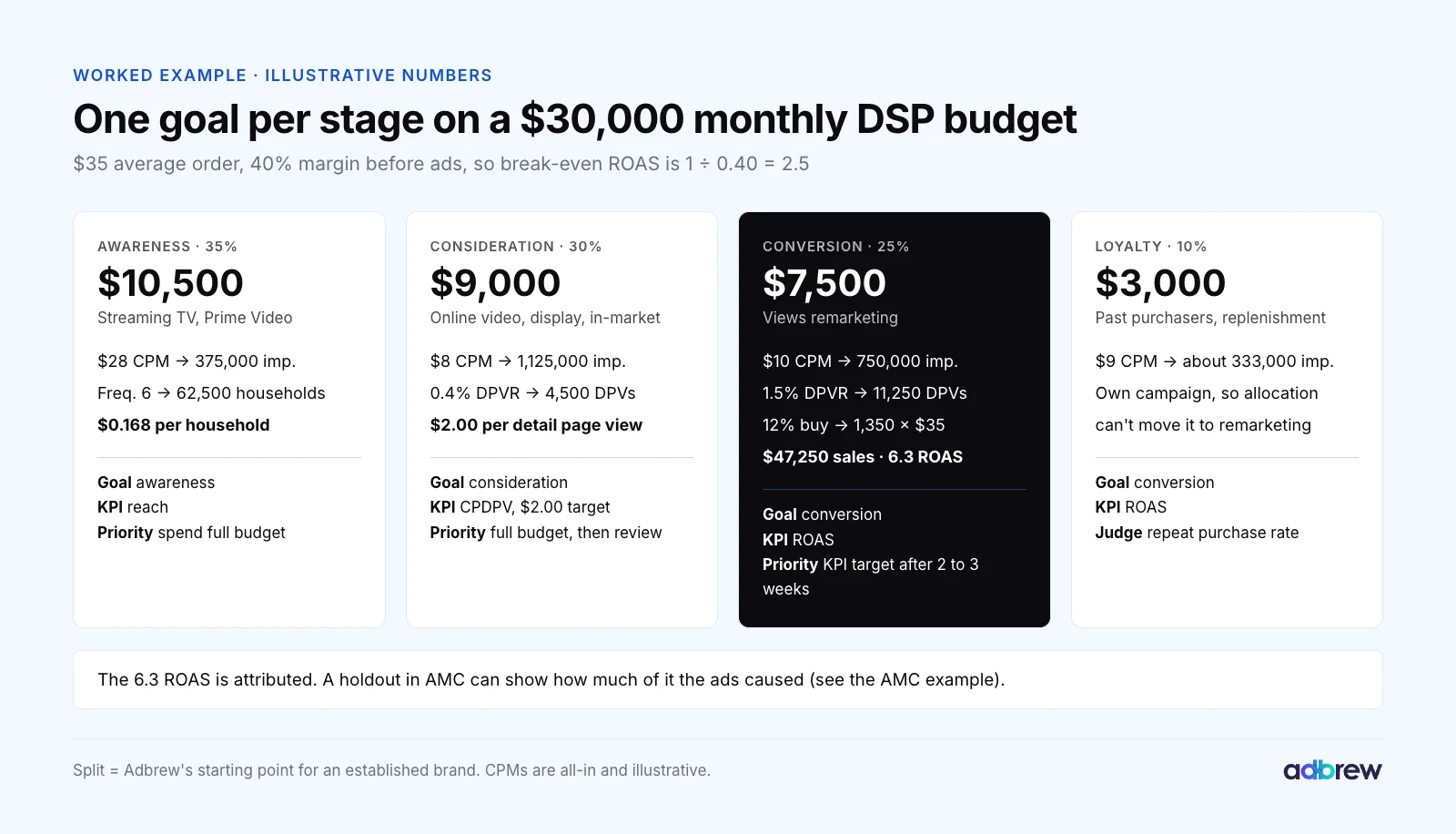
Take an illustrative brand with $30,000 a month of DSP, a $35 average order and a 40% margin before ads. We use the starting split from our full-funnel DSP strategy: 35% awareness, 30% consideration, 25% conversion and 10% loyalty.
1. Awareness: $10,500, Reach KPI
Streaming TV and Prime Video at an illustrative $28 all-in CPM buys 375,000 impressions. At an average frequency of six over the month, that reaches about 62,500 households, or $0.168 each.
Settings: an awareness goal, a reach KPI and spend-full-budget priority. Our frequency capping guide has the weekly caps we start from.
2. Consideration: $9,000, Cost per Detail Page View
Online video and display to in-market audiences at an $8 all-in CPM buys 1,125,000 impressions. At a 0.4% DPVR, that's 4,500 detail page views at $2.00 each.
Settings: a consideration goal and a CPDPV KPI with a $2.00 target, on spend-full-budget priority for the first two to three weeks. Our DSP targeting guide covers the audiences.
3. Conversion: $7,500, ROAS
Views remarketing at a $10 CPM buys 750,000 impressions. A 1.5% DPVR gives 11,250 detail page views, and a 12% purchase rate gives 1,350 purchases.
At $35 each, that's $47,250 in sales and a 6.3 ROAS. Break-even ROAS at a 40% margin is 1 ÷ 0.40 = 2.5, so the line looks safely profitable. Our Amazon DSP retargeting guide covers the windows.
Settings: a conversion goal and a ROAS KPI, moving to KPI-target priority once two to three weeks of data show what's realistic. Hold that 6.3 loosely; the AMC section shows why.
4. Loyalty: $3,000, Conversion Goal on Past Purchasers
Replenishment and cross-sell to past purchasers also run on a conversion goal, usually ROAS. Keep them in their own campaign so allocation doesn't move the money into remarketing.
The two upper stages don't report sales you can bank this month. That is the point of giving them their own goals: the awareness line is judged on 62,500 households, not on the ROAS it was never built to buy.
How to Set a Realistic KPI Target From Your Own Data
Amazon doesn't publish KPI benchmarks for DVA campaigns, and averages from other brands won't match your margin, price or category. The target has to come from your account.

1. Use 2026 Data Only
Pull four to eight weeks of results by ad group from unified reporting, all after January 1, 2026. View-through conversions before that date were counted under the old model, so a 2025 ROAS is not comparable.
2. Read the Column That Matches the KPI
The ROAS KPI counts promoted products only. In unified reporting, "ROAS" includes halo sales of your other products, and the promoted-only figure is ROAS (promoted).
So a ROAS target belongs next to ROAS (promoted). Our Amazon DSP reports guide lists every renamed metric.
3. Total the Period, Don't Average the Weeks
In the worksheet, six weeks of $2,000 spend produced $37,200 in promoted sales, a 3.10 ROAS. Weekly results ranged from 2.6 to 3.8.
Use the period total, not an average of weekly ratios, and never the best week. A 3.8 target would only buy the impressions that look like your luckiest week.
4. Check It Against Break-Even
Break-even ROAS is 1 ÷ margin before ads. At 40%, that's 2.5; our guide to break-even ACOS has the full formula.
A target between break-even and your trailing actual is realistic. In the example we'd set 3.0: above break-even, a little under the 3.10 the line already delivers, so it keeps spending.
5. Work Backward for Consideration Targets
Consideration has no sales to divide. Start from what a detail page view is worth: purchase rate times order value times margin.
If 10% of detail page viewers buy a $35 product at a 40% margin, a view is worth $1.40 in margin straight away. A $2.00 target is then a deliberate investment in new viewers, which is fine as long as you decide it with that number in front of you.
6. Start on Full Budget, Then Tighten
Run new ad groups on spend-full-budget for two to three weeks, put the target in as a scorecard, and switch to Prioritize KPI target only if the trailing number supports it. Amazon's optimization best practices suggest four to seven days between changes.
How AMC Improves Amazon DSP Goal Setting
Unified reporting tells you what each campaign did against its own KPI. Amazon Marketing Cloud tells you what the campaigns did to each other, which is what you need to decide which goal each one should own.
AMC is Amazon's clean room for event-level ad and purchase data. Since September 2025 it opens from the ads console for sponsored ads advertisers too, and since March 2026 Ads Agent can draft and fix its SQL.

1. Path to Conversion: Which Campaigns Feed and Which Close
Path-to-conversion analysis lists the sequences of ad exposures before a purchase, such as streaming TV, then Sponsored Products, then remarketing. A campaign that shows up early in converting paths is a feeder and belongs on an awareness or consideration goal.
In the US, conversion path reporting (beta) also shows your top five 30-day paths across sponsored ads and DSP in the console. It's a quick check before writing a query.
2. Overlap: Do the Stages Work Together?
Overlap analysis compares shoppers exposed to one campaign, both, or neither. In the accounts we manage, shoppers who saw streaming TV and display usually convert better than those who saw one, which is the case for funding the awareness goal at all.
The same analysis covers DSP exposure against sponsored ads purchases. Build an audience of streaming TV viewers in AMC and target it in a consideration campaign, as in our guide to AMC custom audiences.
3. Incrementality: Is the ROAS Real?
Attribution says who saw an ad before buying. A holdout, where one random half of an audience is withheld from ads, says whether the ad caused it.
Back to the worked example. Say the remarketing line's exposed group converts at 0.30% and its holdout at 0.21%. Then (0.30 − 0.21) ÷ 0.30 = 30% of its sales are incremental, and its 6.3 ROAS is about 1.9 incremental ROAS.
That is below the 2.5 break-even. The fix isn't a tighter ROAS target; it's a smaller remarketing budget and more money for the stages that create new demand.
4. Optimal Frequency: Set the Frequency KPI From Data
AMC's Optimal Frequency solution, launched October 15, 2024, needs no SQL. It recommends "a range of values for a recommended daily frequency cap" and can build audiences of under-served and oversaturated shoppers.
Use its range as the target for a frequency KPI, or as the cap on a reach campaign.
5. New-to-Brand and Branded Search: Judge the Upper Funnel
Because NTB isn't a KPI, AMC is where you prove the upper funnel worked. With the five-year retail lookback, a laptop brand can call a buyer new against five years of purchases, not 13 months.
Ad-attributed branded search adds a second test: did the awareness campaign make people search for your brand on Amazon? It also shows which creative prompts those searches.
6. Purchase Overlap: Give Loyalty Its Own Goal
ASIN purchase overlap shows which products your customers buy together and what they buy next. That tells you which product a loyalty campaign should promote, and that its ROAS KPI should count the follow-on ASIN.
Mistakes We See With Amazon DSP Campaign Goals
Prospecting on a ROAS goal. The bidder finds the cheapest ROAS, which is people who were already going to buy. Use consideration and exclusions instead.
Two stages in one campaign. Automated allocation pays whichever ad group buys goal conversions cheapest, almost always remarketing.
A 2025 target in 2026. View attribution changed on January 1, so targets copied from last year leave budget unspent.
Comparing ROAS with ROAS. The KPI counts promoted sales; unified reporting's ROAS counts halo too. Read ROAS (promoted).
KPI target first on day one. Without two to three weeks of data, the target is a guess, and the bidder obeys guesses.
Changing the KPI mid-flight. It resets learning. Launch a new campaign instead.
Judging awareness on sales. Reach and frequency goals were never built to buy 14-day ROAS.
Our list of Amazon DSP mistakes to avoid covers the setup errors we see around them.
How We Set DSP Goals in Adbrew
Everything above works directly in Amazon Ads Agent and AMC. The hard part is keeping goals, targets and AMC analysis consistent across many campaigns and brands, week after week.
Adbrew is an agentic retail media management platform for Amazon and Walmart, and DSP runs in it next to Sponsored Ads, AMC and Marketing Stream:
DSP your way. Run Amazon DSP through Adbrew's seat with no minimum spend, or connect the DSP account you already have. Our team helps set the campaign structure, goals and KPIs.
AMC without SQL. Adbrew's AMC tool has pre-built path to conversion, time to conversion, overlap and new-to-brand reports, refreshed daily, and builds audiences you can send to DSP.
Automation you can read. Rules you set for bids, budgets, audiences and frequency caps, with your thresholds and guardrails, and every change logged.
[Adbrew Intelligence](https://adbrew.io/adbrew-intelligence). Ask an agent for "ROAS (promoted) and new-to-brand share by DSP campaign goal, last six weeks" and it builds the report from your data.
K2 Health lifted conversions 20.28% with AMC on Adbrew, and more than 5,000 brands, agencies and aggregators use the platform.
Pick the Goal, Then Prove It
A DSP campaign goal is a short instruction with long consequences: it picks the KPI, the KPI steers every bid, and the target decides how much budget gets spent. Set them per stage, from your own 2026 numbers, and check them in AMC every month.
Want your DSP goals, KPI targets and AMC reports set up on that logic, through a seat with no minimum spend? Book a demo with our team and we'll walk through your account with you.
Frequently Asked Questions
What are the campaign goals in Amazon DSP?
Amazon DSP campaigns, called Display, Video and Audio campaigns since September 2026, have three goals: awareness, consideration and conversion. Awareness reaches new audiences, consideration drives clicks, video engagement and detail page views, and conversion drives purchases, leads, installs or sign-ups. The goal is set on the campaign and decides which KPIs you can choose.
What KPIs can you choose in Amazon DSP?
Awareness offers reach and frequency (beta). Consideration offers CTR, CPC, cost per video completion, video completion rate, cost per detail page view and detail page view rate. Conversion offers ROAS, total products ROAS, combined ROAS, CPA, cost per install, cost per sign-up and cost per first app open. New-to-brand is not a KPI option.
Which Amazon DSP campaign goal should I choose?
Choose the Amazon DSP goal by funnel stage. Use awareness with a reach KPI for streaming TV and Prime Video, consideration with cost per detail page view for prospecting display and online video, and conversion with ROAS for remarketing and loyalty. Run each stage as its own campaign, so automated budget allocation can't move money between stages.
How do DVA+ objectives relate to campaign goals?
DVA+ asks for an objective such as sales, traffic, awareness or leads. Amazon applies Brand+ to awareness objectives and Performance+ to consideration and conversion objectives. Roughly, awareness maps to the awareness goal, traffic to consideration, and sales and leads to conversion. Advanced settings let you set the goal, KPI, target and bidding priority yourself.
What does "Prioritize KPI target" do in Amazon DSP?
"Prioritize KPI target" tells Amazon DSP to keep the campaign at or near your KPI target, such as a $10 CPA, even if that means leaving budget unspent. The alternative, "Prioritize spending full budget, while maximizing performance," spends the budget and gets the best KPI it can. Use KPI target only after two to three weeks of data.
How do I set a KPI target in Amazon DSP?
Set an Amazon DSP KPI target from four to eight weeks of your own 2026 data, using the reporting column that matches the KPI, such as ROAS (promoted) for a ROAS KPI. Total the period rather than averaging weeks, check the result against break-even ROAS, and set the target between the two.
Can I change the KPI after an Amazon DSP campaign launches?
Yes, but Amazon says changing the KPI after launch resets the campaign's performance learnings and may hurt optimization. Decide the KPI before you save the campaign. To test a different KPI, launch a separate campaign with the same audiences and compare the two over the same weeks.
How does Amazon Marketing Cloud help with DSP campaign goals?
Amazon Marketing Cloud shows how campaigns affect each other. Path-to-conversion analysis shows which campaigns feed and which close, overlap shows whether stages work together, holdouts measure incremental ROAS, and the Optimal Frequency solution recommends a daily cap. That tells you which goal and target each campaign should have.


