
Walmart SEO in 2026: How to Rank Higher on Walmart

Shrey Chaudhary

TL;DR
Key takeaways
Walmart SEO is optimizing listings so Walmart search retrieves them for relevant queries and ranks them above competing items.
Relevance gets you into results; price, delivery speed, reviews, stock and sales history decide your position.
Walmart's 2026 rules: titles up to 150 characters, 3 to 10 key features of 80 characters, descriptions of 150+ words.
Sponsored Products build the sales history organic search rewards, so ads and SEO work best as one plan.
Most Walmart sellers we audit treat SEO as a copywriting job. They rewrite titles, then wonder why rank doesn't move.
Walmart search reads your content to decide whether you are relevant. It then ranks you on the things a shopper cares about: price, delivery speed, reviews and whether the item sells.
This guide covers both halves as they work in October 2026, plus what Walmart's AI assistant Sparky changes and how Walmart Connect ads feed organic rank.
What Is Walmart SEO?
Walmart SEO (search engine optimization) is the work of making product listings rank higher in Walmart.com and Walmart app search results. It covers listing content, attributes and images, plus the offer signals Walmart weighs: price, delivery speed, stock, reviews and sales performance.
It matters more every quarter. Walmart reported U.S. marketplace net sales up more than 50% in its Q2 FY27 results (the quarter to July 31, 2026), so more sellers compete for the same search results.
Sellers also call it Walmart Marketplace SEO, and it is not Google SEO. You don't build backlinks or tune page speed. You control the listing, the offer and, through Walmart Connect, how much paid traffic the item gets.
How Walmart Search Ranks Listings in 2026
Walmart doesn't publish its ranking formula or weights. What it does publish, across Seller Center guides and executive comments, points to a two-stage system.

Stage 1: Relevance Decides Whether You Show Up
The paper Semantic Retrieval at Walmart (KDD 2022) describes the hybrid system deployed in Walmart search: a traditional keyword index combined with an embedding-based neural model. The neural side exists to handle long, specific "tail" searches that exact keyword matching misses.
In practice, that means two things. Exact words still matter in your title and key features, but the model also understands meaning, so "insulated tumbler for hot coffee" can match an item that never uses those exact words.
Walmart's product details policy, updated October 6, 2026, says the title, description, key features, images and attributes "help determine how your items appear in search and browse results." Product type and category decide which attributes you can fill, so a wrong product type quietly removes you from filtered searches.
Stage 2: The Retail Fundamentals Decide Where You Rank
Once you are relevant, you compete on the offer. Ryan Mayward, who runs Walmart Connect in the U.S., put it plainly at the Goldman Sachs Communacopia conference on September 9, 2026.
Sellers, he said, "will compete on retail fundamentals, having the lowest possible price, having the fastest shipping speed, having great ratings and reviews, great content on their item detail pages." The other way they compete is advertising, mainly paid search.
Signal | What Walmart measures | Where you see it |
|---|---|---|
Relevance | Title, key features, description, product type, attributes | Search Insights keyword opportunities |
Listing Quality | Content, price, shipping, in stock, reviews (0 to 100) | Listing Quality dashboard in Seller Center |
Price competitiveness | Your price against similar items on other marketplaces | Pricing insights dashboard |
Delivery speed | Promised delivery speed across ZIP codes | Listing Quality shipping score, delivery tags |
Ratings and reviews | Review count and average rating | Item page, Listing Quality |
Sales performance | Impressions, clicks, add-to-carts and orders over time | Search Insights rank metrics |
Buy Box and stock | Whether your offer wins and is available | Buy Box and inventory reports |
The order we fix things in follows the table. A perfect title can't rank an item that is out of stock, priced above Amazon or promising seven-day delivery.
The Walmart Listing Quality Score, Component by Component
The Listing Quality score is Walmart's own health check for each listing. Walmart's Listing Quality overview, updated April 9, 2026, splits it into five components, and the catalog score is the average of your item scores.

Content quality. How well the item name, description, key features and images work.
Price competitiveness. Your price compared with similar products on external marketplaces.
Shipping. Your promised delivery speed across ZIP codes. Items over 50 pounds or priced at $10 or less are excluded.
Published and in stock. How often the item was available to customers over the last seven days.
Ratings and reviews. The number of reviews and the average rating.
Walmart's Listing Quality API returns the same parts as separate 0 to 100 scores, plus post-purchase quality as a count of items with defects. If you manage a large catalog, pull it weekly rather than clicking through the dashboard.
Walmart says quality listings "drive higher conversion rates and boost product visibility," but it gives no thresholds or weights. In the accounts we manage, content quality is the fastest to move and price competitiveness the one most often ignored.
There is a practical bar worth knowing. Walmart's Review Accelerator programs require a content quality score of 70% or higher before an item can join the Recognized Reviewer program.
Walmart Listing Content Rules for 2026
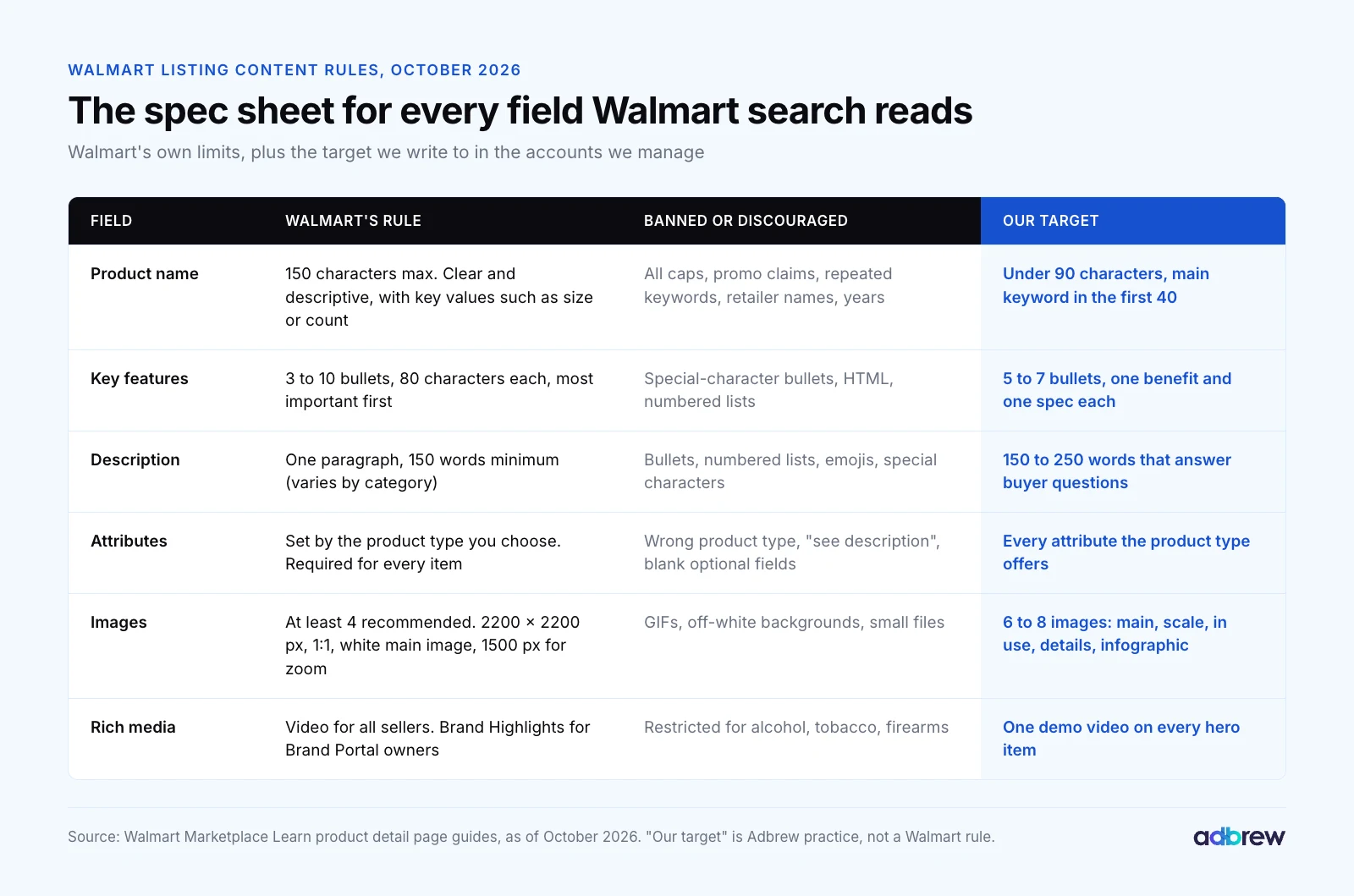
These are Walmart's own limits as of October 2026, with the targets we write to. The spec sheet below puts them on one page.
1. Write the Title for Shoppers and Search
The U.S. title limit is 150 characters under the product details policy. Walmart bans all caps, special characters, promotional claims, retailer names, URLs, non-English text, years and repeated keywords.
Walmart's keyword optimization guide, updated April 14, 2026, adds one rule we follow everywhere: pick one or two primary keywords and use each once in the title, the description and the key features.

We put the brand first, the item name (the main keyword) next, then the qualities that separate the product, then size and pack count. We aim for under 90 characters, because mobile results cut long titles and Walmart's Canada guide suggests 50 to 75 characters without spaces.
2. Use Every Key Feature Slot
Walmart allows three to 10 key features, each up to 80 characters with spaces, most important first. No special-character bullets, HTML or numbered lists.
We write five to seven, each pairing a benefit with a spec: "Keeps drinks cold for 24 hours with double-wall vacuum insulation." That one line answers a shopper question and carries two search phrases.
3. Write a Real Description
The description must be one paragraph of at least 150 words, with requirements that vary by category. No bullets, numbered lists or emojis.
Use it for the long-tail phrases and the questions people ask before buying: what fits, what's included, how to clean it, who it's for. That is also the text an AI assistant reads when a shopper asks a question, which matters more now (see the Sparky section below).
4. Fill Every Attribute the Product Type Offers
Walmart's attribution and categorization guide is blunt: "Without attributes, customers will likely have a hard time finding your items on Walmart.com." Attributes feed the filters shoppers click, such as size, color and material.
Choose the product type first in Walmart Seller Center, because it decides which attributes the item spec lets you set. Walmart keeps adding types: on October 19, 2026 it introduced new Automotive product types and attributes, with some legacy types retiring in early 2027, per its release notes.
5. Meet the Image Specs, Then Go Past the Minimum
Walmart's image guidelines, updated May 12, 2026, recommend at least four images per listing. They should be 2200 x 2200 pixels, square (1:1), with a pure white (RGB 255, 255, 255) background on the main image.
Images need at least 1500 x 1500 pixels for zoom, and GIFs aren't allowed. We use six to eight: main, scale, in use, close-ups and one infographic that restates the top key features.
6. Add Video and Brand Highlights
All sellers can add video, and registered brand owners can add Brand Highlights, per Walmart's rich media guide updated October 19, 2026. Brand Highlights combine images, video and text, and you can apply them to up to 500 items at a time.
Brand Highlights need a Walmart Brand Portal registration with no IP or Trust and Safety violations. Walmart says rich media can "increase order conversions," and conversion is the signal that feeds rank.
For a field-by-field walkthrough with more examples, see our guide to Walmart listing optimization.
Walmart Keywords: Where They Go and How to Find Them
Keyword research for Walmart deserves its own guide, and our Walmart keyword research guide is it. Here is the short version for SEO.
Find terms in three places: Walmart's search bar suggestions, the search terms report from your automatic Sponsored Products campaigns, and Seller Center's Search Insights. On October 21, 2026, Walmart added Search themes to Search insights, which surfaces trending searches you can build content around.
Then place them by job. The main keyword goes in the title, supporting terms in key features, long-tail phrases and synonyms in the description, and facts like size and material in attributes.
Price, Fast Shipping and Reviews: The Offer Side of Walmart SEO
These three are where most rank is won or lost, and none of them is copywriting.
1. Price Against the Rest of the Internet
Walmart's price competitiveness score compares your price with similar products on other marketplaces, not just other Walmart sellers. If the same item is cheaper on Amazon or your own site, expect it to show up here.
Price also decides the Buy Box. Walmart's Buy Box guide says it weighs price, shipping fee, delivery speed, seller performance and customer experience. Our Walmart Buy Box guide covers how to win it.
2. Faster Delivery Promises
Delivery speed feeds the shipping component of Listing Quality, and Walmart's Expedited Delivery page says TwoDay and OneDay items "benefit from filter inclusion and delivery tags." Shoppers who filter for fast delivery never see a slower item.

ThreeDay needs no approval. Seller-fulfilled TwoDay and OneDay need 90+ days selling or 100+ orders, on-time and valid tracking rates above 95%, cancellations below 1.5% and free returns.
With Walmart Fulfillment Services (WFS), TwoDay is automatic. Walmart's Marketplace homepage reports 50% average GMV growth for items with the "Fulfilled by Walmart" tag and a promise of two days or less (Walmart data, February 2025 to March 2026). Our Walmart 2-day shipping guide covers the seller-fulfilled route.
3. Reviews, Through Walmart's Own Programs
Walmart scores ratings and reviews on count and average rating, and it doesn't let sellers solicit reviews outside its programs. Its Review Accelerator, updated September 25, 2026, has two.
Post-Purchase Reviews offers buyers an incentive to review items with fewer than 15 reviews (or none in 90 days) and at least one recent sale. Recognized Reviewer sends free samples to trusted reviewers, for new-condition items with fewer than 15 reviews and that 70% content score.
Our guide to getting reviews on Walmart covers both, plus review syndication from your own site.
Sparky and AI Shopping: What Changes for Walmart Discovery
Sparky is Walmart's generative AI shopping assistant. Walmart launched it in June 2025 in the Walmart app, where it helps customers find items, "synthesize reviews" and compare products across all categories.
Adoption is growing fast. At the September 2026 Goldman Sachs conference, Walmart said Sparky's weekly active customers had doubled year over year, with 60% quarter-over-quarter growth in weekly use, and that Sparky shopping trips have an average order value 40% higher than other trips.
Shoppers use it to research before they buy. In a Walmart survey from August 2025, 81% of surveyed customers said they'd used Sparky to check product availability and review specifications before purchasing, per Walmart Connect.
Walmart is also opening its catalog to outside AI agents. It partnered with OpenAI in October 2025 for shopping inside ChatGPT, and on October 21, 2026 it announced Agent Profiles and an Agent Gateway, alongside integrations with ChatGPT, Gemini and others.
What Walmart Has and Hasn't Said
Walmart has not published how Sparky chooses which products to show. Anyone claiming a "Sparky ranking formula" is guessing.
On ads, Walmart Connect says it tested its first ad formats tied to Sparky in fall 2025 and is continuing in 2026. It hasn't published self-serve specs, so we treat Sparky ads as something to watch, not to plan a budget around yet.
What We Do Differently Because of Sparky
What we can say from how assistants like Sparky work is that they answer questions using your listing text, attributes and reviews. A listing that states facts plainly gives an assistant something to quote.
Fill attributes completely. "Dishwasher safe: Yes" is easier for an assistant to use than a vague line in the description.
Answer real questions in the description. Fit, compatibility, what's in the box, care instructions.
Fix the cause of bad reviews. An assistant that summarizes reviews will repeat your most common complaint.
Keep facts consistent. The same size, count and materials in the title, key features, attributes and images.
None of this is wasted if Sparky's role changes. It is the same work that raises content quality and conversion in regular search. Amazon's assistant works similarly, and our guide to Amazon Rufus covers that side.
How Walmart Connect Sponsored Products Lift Organic Rank
Sponsored Products are Walmart's cost-per-click search ads, and they are the fastest way to give a new or low-ranked item the history organic search rewards. Walmart says so in its own Sponsored Products best practices.
Advertising your items, it says, helps "build relevancy (and historical performance) to increase item's organic and paid rankings with this higher traffic." Walmart has not published how much, and the effect depends on the listing converting.

1. Make the Item Eligible
Walmart's Sponsored Search guide, updated October 1, 2026, says an item must be in stock, winning the Buy Box and published to advertise. Ads are then selected "based on relevancy and bids."
That relevance also sets your price. Since 2022, U.S. Sponsored Search has used an advanced second-price auction, so a relevant, converting listing can win placement and pay less per click than a higher bidder.
2. Launch an Automatic Campaign on Items That Convert
An automatic campaign finds the search terms for you. Pick items with good content, a competitive price and fast delivery, because paid clicks on a weak page build no useful history.
Walmart's own numbers make the case for starting: marketplace advertisers averaged a 5:1 return on ad spend on Sponsored Products in FY26, per the Marketplace homepage. Our guide to Sponsored Products placements shows where those ads appear.
3. Move Winning Terms Into Manual Campaigns and Listings
Terms that convert in the automatic campaign go into manual exact and phrase campaigns, and the best ones go back into your title and key features. That is where ads and SEO meet.
Since July 2026, Walmart supports negative keywords for Sponsored Products, so you can stop paying for irrelevant searches that teach the algorithm nothing useful. Our Walmart bidding strategies guide covers how to set bids from your margin.
4. Watch Organic Rank, Then Rebalance
Search Insights shows Impressions rank, Clicks rank, Added to cart rank and Sales rank for each item within its product type. A lower number means stronger performance, and the chart annotates your content and price changes.
When an item holds the top organic spots for a term, we lower bids there and move budget to the next term it can't rank for yet. We keep brand terms covered, because since June 2025 competitors can buy positions 1 and 2 on branded searches, as our Walmart Connect guide explains.
How to Measure Walmart SEO
Track a small set of numbers every week, on your top 20 items first.
Search Insights ranks for each item, especially Impressions rank and Sales rank.
Listing Quality score at item level, and which component dropped.
Conversion rate for each item, from Seller Center analytics.
Organic share of sales: total item sales minus ad-attributed sales, divided by total sales. If it rises while ad spend holds, SEO is working.
Buy Box win rate and in-stock rate, because both reset rank fast when they slip.
Give a content change two to four weeks before judging it. Search Insights updates weekly, and a single week rarely tells you much.
Walmart SEO vs Amazon SEO
The two engines reward the same fundamentals, but the details differ enough to trip up sellers who copy listings across.
Walmart | Amazon | |
|---|---|---|
Title limit | 150 characters (U.S.) | 75 characters in most U.S. categories from July 27, 2026 |
Bullets | 3 to 10 key features, 80 characters each | Bullet points plus the new Item Highlights field |
Price check | Scored against other marketplaces | Buy Box and pricing health |
AI assistant | Sparky | Rufus, now part of Alexa for Shopping |
The biggest practical difference is price. Walmart explicitly scores you against prices elsewhere, so a listing that is cheaper on Amazon is penalized on Walmart. Our guide to the Amazon search algorithm covers Amazon's side.
Walmart SEO Mistakes We See in Real Accounts
Pasting Amazon listings into Walmart. Different limits, different content rules, and often the wrong product type.
Stuffing titles. Repeated keywords and promo words break Walmart's rules and read badly on mobile.
Leaving attributes blank. The item disappears from every filtered search.
Ignoring price parity. A higher price than other marketplaces drags the Listing Quality score down.
Slow delivery promises. Without TwoDay or ThreeDay, the item misses fast-delivery filters and tags.
Advertising weak listings. Paid clicks on a page that doesn't convert build no history and waste budget.
Judging changes after three days. Rank data updates weekly. Wait two to four weeks.
How We Run Walmart SEO and Ads Together in Adbrew
Listing work happens in Seller Center. The part that eats time is the advertising side: finding the terms, moving them into campaigns, cutting waste and tracking which items have earned organic rank.
Adbrew is an agentic retail media management platform for Amazon and Walmart, and Walmart Connect management is part of it:
Sponsored Products, Sponsored Brands and Sponsored Videos in one place, with reporting by campaign, item and keyword.
Rules you set for harvesting converting search terms, negation, bids and budgets. Our guide to Walmart automated rules shows the logic.
Bulk actions for bids, budgets and keywords across campaigns.
Adbrew Intelligence and Adbrew MCP. Ask for "Walmart search terms with orders that aren't in my titles yet" and an agent builds the list from live data. Changes are drafted and applied only after you approve them.
Adbrew is recognized at Walmart Connect, and brands on Adbrew cut ACOS by 46% on average. When an account is ready to scale, our Walmart PPC audit checklist is the first review we run.
Rank on the Fundamentals, Then Buy the Head Start
Walmart SEO in 2026 is a retail job as much as a content job. Get the listing right, price it competitively, promise fast delivery, then use Sponsored Products to build the history that lets organic rank take over.
When you are ready to run Walmart Connect alongside your Amazon ads, book a demo with our team and we'll walk through your account with you.
Frequently Asked Questions
What is Walmart SEO?
Walmart SEO is the practice of optimizing product listings so they rank higher in Walmart.com and Walmart app search results. It covers titles, key features, descriptions, attributes and images, plus the offer signals Walmart weighs: price competitiveness, delivery speed, stock, ratings and reviews, and sales performance.
How does Walmart's search algorithm work?
Walmart's search algorithm first retrieves items relevant to the query, using keyword matching plus a semantic model that understands meaning. It then ranks those items on retail fundamentals: price, delivery speed, ratings and reviews, content quality and sales history. Walmart does not publish the weights of each factor.
What is a good Walmart Listing Quality score?
Walmart doesn't publish a target Listing Quality score, and scores run from 0 to 100. Aim to improve the weakest component first. One concrete bar: Walmart's Recognized Reviewer program requires a content quality score of 70% or higher, so treat 70% content quality as a minimum.
How long should a Walmart product title be?
A Walmart product title can be up to 150 characters in the U.S. In the accounts we manage, titles under 90 characters with the main keyword in the first 40 perform best on mobile. Walmart's Canada guide suggests 50 to 75 characters without spaces.
Does Walmart Connect advertising help organic ranking?
Yes. Walmart's own Sponsored Products best practices say advertising helps build relevancy and historical performance that increase an item's organic and paid rankings. It works only when the listing converts. Ads on a weak page buy clicks without the orders that build history.
How does Sparky affect Walmart SEO?
Sparky, Walmart's AI shopping assistant, answers shopper questions by finding products, summarizing reviews and comparing options. Walmart hasn't published how Sparky picks products. Complete attributes, descriptions that answer real questions, consistent facts and strong reviews give it more to work with.
Does fast shipping improve Walmart search ranking?
Yes. Delivery speed is part of the Listing Quality score, and Walmart says TwoDay and OneDay items get delivery tags and inclusion in fast-delivery filters. Items in Walmart Fulfillment Services get TwoDay automatically and the "Fulfilled by Walmart" tag.
How long does Walmart SEO take to work?
Walmart SEO changes usually take two to four weeks to show in rank. Search Insights data updates weekly, and a new item needs sales history before organic rank moves. Sponsored Products shorten that wait by bringing clicks and orders sooner.


