AI in Amazon advertising: What it actually means in 2026

Shivam Kumar
AI is rapidly changing how brands manage Amazon Ads. From campaign optimization to keyword research and performance analysis, AI helps advertisers make smarter decisions faster.
In this article, we'll look at the biggest ways AI is reshaping Amazon advertising.
AI in bid and budget optimization
This is where the word is used most loosely, and where it moves your money, so it is worth pulling the pieces apart. Three different things are all called optimization AI here.
1. Amazon's auction AI
Underneath every impression, Amazon's own models predict how relevant a product is to a query and how likely a shopper is to click and buy, then price the auction on that basis. Two advertisers can bid the same on the same keyword and land in different spots because one listing scored as more relevant. You do not switch this on, and no tool tunes it. Your only influence is indirect, through listing quality and conversion rate, and it is the influence that matters most.
2. Amazon's automated campaigns
Amazon's own trained models sit one layer up. Performance+ and Brand+ set bids and pick audiences toward a target, scoring shoppers on likelihood to convert and adjusting in near real time, with reporting Amazon calls glass box over a model you do not actually tune. Amazon reports 30 to 90 percent lower CPAs against standard buys with the same goal.
3. Third-party tools: two kinds of optimization
Most third-party tools add two of these, and both get called AI, so it is worth being exact about what each one is.
4. Rule-based automation is logic you write and the software runs.
You set the condition and the action, and it acts when the condition is met. If a placement converts under your target ACOS, raise its bid. If a search term spends past a ceiling with no sale, add it as a negative. If a query converts well, harvest it into its own keyword. The system checks those conditions on a schedule and does exactly what the rule says. It does not learn, and it does not improvise, and that is the value of it: you can read the reason for every change, and you can rewrite the logic the same afternoon your strategy changes. A capable engine handles moving thresholds, several lookback windows at once, and conditions tied to retail signals rather than ad metrics alone. It is still only ever doing what you told it to.
5. Statistical and ML optimization is a trained model deciding for you
Instead of fixed rules, it reads your historical performance, usually with time-series models, predicts where bids, budgets, and audiences should move next, and adjusts on its own as new data lands. It picks up patterns a person scanning reports would miss, and it scales without a handwritten rule for every case. The cost is visibility. You largely cannot see inside the model or tune it, it needs a decent volume of data to learn from, and it is least reliable exactly when your business turns, a stockout, a price war, a new competitor, because those are the moments its training no longer matches what is happening.
The optimization options placed on control, from a rule you rewrite to an auction you cannot see into.
Whichever a tool offers, the useful question to ask a vendor is which of the two it runs, what data it reads, and whether you can see and override its decisions. Adbrew offers both rule-based and AI-powered automation, and ties them to retail signals the auction and the black box cannot see: Buy Box, days of stock, hourly organic rank, and true contribution margin.
AI for creative
Creative is the most clear-cut case. When someone says AI made the ad, they mean generative AI, and it is not confused with optimization. It is also a low-risk place to start using these tools.
Amazon has released a full set of creative tools. Its image, video, and audio generators turn a product listing into finished assets. The Video Generator produces six variations from a single image, can take the useful clips from a longer video you upload, and accepts your logo. Creative Agent is a chat tool that researches the product, suggests concepts, storyboards them, and builds the ad. It runs on AWS Bedrock with Amazon's Nova and Anthropic's Claude models. Amazon reports that advertisers using its Image Generator saw about five percent more sales on average in its early period. The tools are free to use.
The output is good now. Amazon's image and video tools produce assets you can run as they are, so the question is less whether they work and more how you use them. A simple way to get value from them:
Start with your best-sellers.A small increase in click-through on high-volume ASINs is worth more than strong creative on low-volume products.
Give it your brand material.Upload your logo, brand guidelines, and a few of your best existing assets so the output reflects your brand.
Generate several versions and test them.Run them as an A/B test against your current creative, and use click-through and conversion rate to decide.
Match the format to the placement.Create the aspect ratios each placement needs. Sponsored Brands video, product detail-page video, and streaming require different cuts.
Plan the concept elsewhere, then build in Amazon's tools.ChatGPT or Claude are better for the messaging and positioning. Draft the concept there, then build the on-Amazon asset in Amazon's tools, which have the retail context.
TipUse the generated images outside of ads too. The same lifestyle images can improve your product detail pages and A+ content. They also help on Amazon's AI shopping surface, because Amazon builds its in-conversation ad copy from your listing and Brand Store content, so better pages produce better answers when a shopper asks the assistant.
AI for reporting and analysis
If you want a use for generative AI that pays off now and cannot burn budget, it is analysis, not bidding. A wrong answer here costs a second look, not spend, which makes it the safest place to build trust before you let AI touch money.
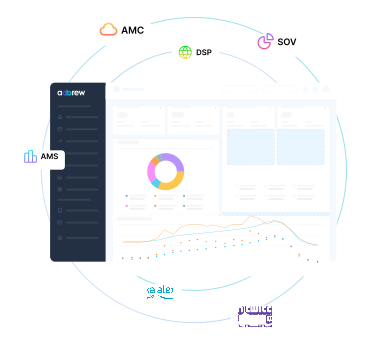
Inside Amazon, the Ads Agent writes Amazon Marketing Cloud SQL from a prompt, turning a question that used to wait on an analyst into a sentence. On the platform side, third-party tools take this further, because a good analysis agent needs more than ad data. Adbrew's AI Agent for Deep Analysis reads across campaigns, DSP, AMC, and live retail performance in one place, so it can answer questions that only make sense when paid and organic are seen together. The jobs where this genuinely helps:
Root-cause on a metric move. Why ACOS climbed last week, traced to the placements, terms, or products behind it, not just flagged.
Weekly and client summaries. A messy account condensed into the three things that changed and why, ready for a review.
AMC without SQL. Path-to-purchase, new-to-brand cost, and time-to-convert asked as questions instead of queries.
Anomalies and hygiene. Spend spikes, overlapping keywords, and missing negatives surfaced before they cost you.
Two habitsCheck the numbers, and keep it read-only at first. Language models can misread a table with full confidence, so spot-check the figures behind any answer. And point these tools at analysis before you grant anything that spends, so you learn where the reasoning holds on low stakes.
Co-pilots and MCP
The newest layer is the assistant that acts inside the account, and the plumbing that connects your data to it. Amazon is building on both fronts, and so is the tooling around it.
Amazon's Ads Agent is a co-pilot in the console that plans, builds, and optimizes from plain English. Alongside it, Amazon opened its Ads MCP Server in beta. MCP, the Model Context Protocol, is an open standard from Anthropic that lets an agent in Claude, ChatGPT, or Gemini reach the Ads API through one integration instead of a custom build per tool. Third-party platforms are shipping their own MCP servers too, and Adbrew is bringing one as well, so your account is reachable from the assistant you already use.
Two things the hype skips. MCP does not replace the Ads API and does not make your PPC profitable on its own. And a generic chat connected this way reasons over whatever it is handed, which is often ad data alone, blind to inventory, margin, Buy Box, and rank.
Where context changes the answer
That blind spot is the real story of this layer. A model is only as good as what it knows about you, and connecting it to raw ad data is not the same as making it useful. The more valuable pattern that some third-party platforms are taking is to build the agent deeply inside the platform, where it already sits on your campaigns, your retail data, and your history, so you use AI inside your existing workflow rather than exporting to a chat window. That is what Adbrew Intelligence is: agentic AI layered on the advertising engine, running across launch, optimization, reporting, DSP, and AMC.
Context is the difference. Adbrew includes a context management system where you configure your own context, goals, margins, brand rules, and priorities, and the platform layers its retail and account context on top. Every AI action is grounded in it, so when the agent answers "raise this bid," it already knows your margin and your stock, not just your ACOS.
What comes next
The lines between these are already softening. Generative models are moving toward the optimization work that belonged to trained statistical models, and agents are taking over more of the operating, from building campaigns to reading the account and acting on it.
The larger shift is on the shopper side. Amazon's assistant, now past 250 million users, is changing how demand forms, and ads increasingly appear inside the AI answer, with the copy generated from your listing content. As buying moves into conversation, part of optimization becomes being the product the assistant recommends, which loops back to the detail page and the auction layer. The jobs connect.