What is Amazon Ads MCP?

Shivam Kumar

Amazon Ads MCP lets an AI assistant run Amazon Advertising in plain language. You describe what you want, and the assistant makes the change in your account.
Amazon released its own MCP server in open beta on February 2, 2026. Several third-party servers now run alongside it.
This guide covers what it is, how a request works, what you can do with it, and what it still cannot see.
TL;DR
MCP is an open standard for connecting AI assistants to outside tools. An Amazon Ads MCP server exposes advertising actions, reporting, campaign changes, bid and budget updates, as tools an assistant like Claude, ChatGPT, or Gemini can call.
What is MCP?
MCP, the Model Context Protocol, is an open standard from Anthropic for connecting AI applications to outside tools and data.
Before it, each AI tool needed a custom integration to each platform. Ten tools and twenty platforms meant two hundred connections to build and maintain. Developers call this the N by M problem.
A server built on MCP turns that into one connection per platform. Any assistant that speaks MCP can use it.
What is Amazon Ads MCP?
An Amazon Ads MCP server exposes Amazon Advertising operations as tools an AI assistant can call. It does three things:
Authenticates to your account through the Amazon Ads API.
Offers a set of actions, such as
get_campaign_report,update_bid,create_campaign, andadd_negative_keyword.Let any MCP-compatible client, Claude, ChatGPT, Gemini, or a custom agent, call those actions for you.
A typed request becomes a real change in your account.

How does a request work?
Underneath a plain-language request sits a short, repeatable exchange between three parts: the AI application you type into, an MCP client inside it, and the MCP server that holds the tools and talks to Amazon.
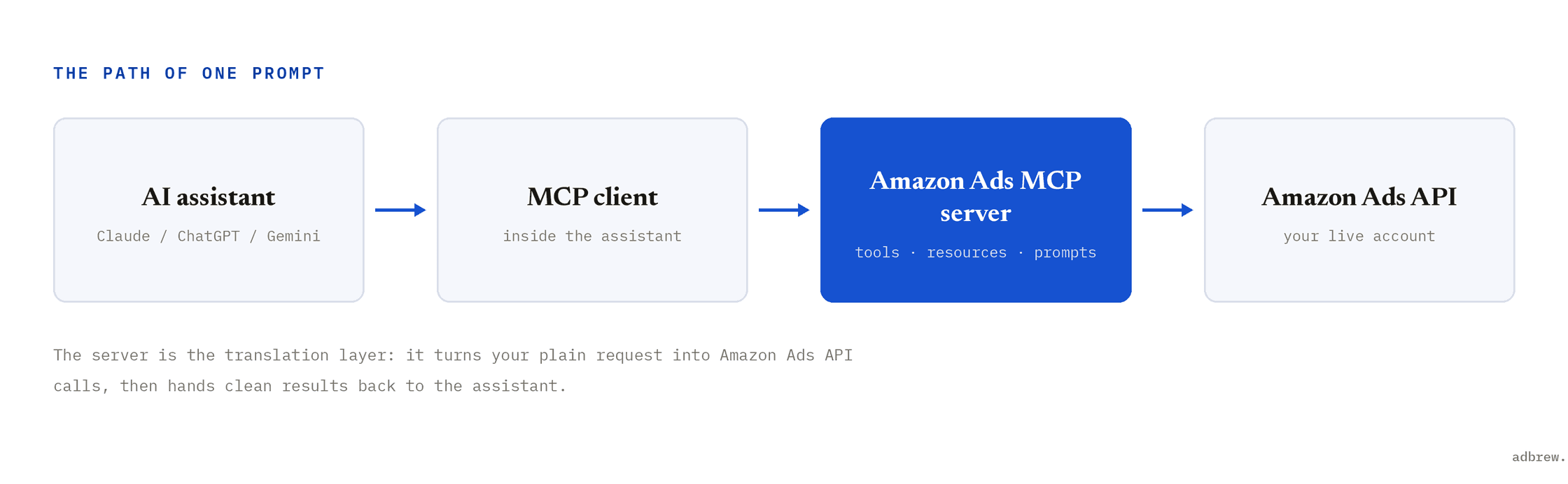
Each request runs through the same five steps:
Discover: The client asks the server which tools exist and reads what each one needs.
Select: The model maps your request to a tool and fills in the details, the keyword, the bid, and the date range.
Authorize: The server uses your credentials to act, refreshing tokens as needed.
Execute: The tool call becomes one or more real Amazon Ads API requests.
Return: Structured results come back for the model to read out or act on.
The server handles the tedious parts: holding your credentials, refreshing tokens, and running Amazon's asynchronous reporting flow.
What can you do with it?
The clearest way to understand the range is to look at what you would type. Requests fall into two groups that behave very differently, so it helps to keep them apart from the start.
One quirk is worth knowing early. Telling the assistant to do something, change a bid, pause a keyword, happens right away. Asking it to tell you something kicks off Amazon's reporting flow, which runs in the background, so a report can take a few minutes and a heavy query can take much longer. The action feels instant, the answer often does not.
Amazon's official MCP server
Amazon's official Amazon Ads MCP Server reached open beta on February 2, 2026. It is available to any Amazon Ads API partner with active credentials.
Through one integration it connects Claude, ChatGPT, Gemini, or a custom agent.
It can create, update, or delete campaigns, run reports, manage account settings, and reach billing data.
It also bundles common jobs into pre-built tools. One builds an end-to-end Sponsored Products campaign from a single prompt. Another expands a campaign into a new country in one step.
Amazon added these tools after its own tests showed agents taking risky paths, such as pulling too much Amazon Marketing Cloud data or calling outdated APIs.
One caveatAmazon shipped API specifications, not a finished app. Connecting it takes setup, and most of the guardrails on actions that spend are your responsibility, not something the server enforces for you out of the box.
Is it safe to let AI change campaigns?
This is the right question, and the answer depends more on how you run it than on Amazon. A workable posture:
Start read-only: Reporting and analysis cannot spend money. Begin there and learn where the assistant is reliable before it can touch anything.
Keep a human on writes: The server executes what you ask. It does not stop to judge whether the strategy is sound, so bid and budget changes need review before they run.
Set hard budget caps in your account that the assistant cannot override.
Prefer a hosted server that stores your credentials properly and logs every action, so there is a trail when something moves.
Amazon's fix for its own off-script agents says a lot too. It was not a smarter model but tighter control, forcing agents onto approved paths. That is where this technology sits today: capable and not ready to run unsupervised.
What the MCP server cannot see?
The bigger limit is context. An Amazon Ads MCP server connects to advertising data only.
It sees spend, clicks, ACOS, and campaign structure. It does not see your inventory, real margin, Buy Box, or organic rank.
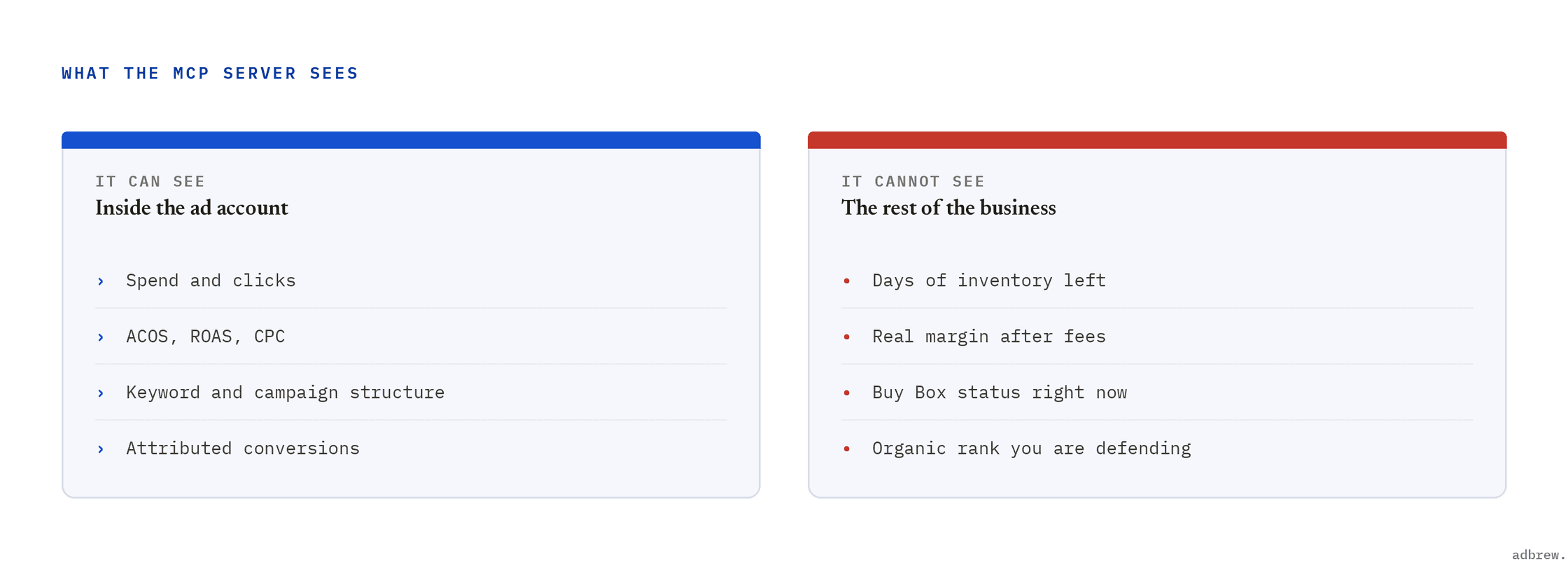
So an agent may raise a bid on a product that is nearly out of stock, or one that just lost the Buy Box. The change is right on ad data and wrong for the account.
Where does a platform like Adbrew fit?
A model is only as useful as what it knows about you. Ad data alone leaves out what decides whether a bid is right.
Some platforms build the agent inside the platform, on top of your campaigns, retail data, and history. You use AI in your existing workflow instead of a separate chat window.
That is Adbrew Intelligence: agentic AI on the advertising engine, across launch, optimization, reporting, DSP, and AMC.
Adbrew is also bringing its own MCP server, so your account is reachable from the assistant you use, with retail context attached.
Adbrew adds a context management system. You set your goals, margins, and priorities, and the platform grounds each AI action in them, plus live signals like Buy Box, days of stock, hourly rank, and contribution margin.