Amazon Sponsored TV Ads in 2026: Now Streaming TV

Shivam Kumar

TL;DR
Key takeaways
Amazon Sponsored TV was a self-serve streaming TV ad with no minimum spend, CPM bidding and daily budgets.
In 2026 Amazon renamed it "Streaming TV", bought through Display, Video, and Audio campaigns in Amazon Ads Agent.
Existing Sponsored TV campaigns keep running; DVA+ rolls out in the US first, while other countries keep the classic flow.
Judge streaming TV on reach, branded searches and new-to-brand customers, never on 14-day ROAS.
Amazon Sponsored TV ads were Amazon's self-service way to put a video ad on Prime Video, Twitch, Fire TV and partner streaming apps, with no minimum spend.
In 2026 the product got a new name and a new home. This guide covers what Sponsored TV was, what happened to it, how you buy streaming TV today and how we budget and measure it in the accounts we manage.
What Are Amazon Sponsored TV Ads?
Amazon Sponsored TV was a self-serve streaming TV ad type in the Amazon Ads console. Brands bought full-screen, non-skippable video ads on a CPM (cost per thousand impressions) basis, set a daily budget and picked audiences, with no minimum spend and no upfront commitment.
Amazon's own Sponsored TV page now describes it in the past tense: a self-service streaming TV solution "for businesses of any size and level of TV advertising experience to purchase inventory with no minimum spend."
It launched at unBoxed in October 2023 for US sellers and vendors. At launch it ran on Freevee, Twitch and third-party apps on Fire TV; Amazon's current streaming TV guide lists Prime Video, Twitch and Amazon Publisher Direct apps.
What made it different from buying TV through Amazon DSP was the buying model. It behaved like a sponsored ad: a campaign, an ad group, a bid per audience and a daily budget, all inside the console you already used for Sponsored Products.
Sponsored TV (2023 to 2026) | Streaming TV through DSP / DVA | |
|---|---|---|
Where you bought it | Sponsored ads console, self-serve | DSP, now Display, Video, and Audio campaigns |
Minimum spend | None | None self-service; managed service $50,000 |
Pricing | CPM, bid per audience | CPM, plus deals and bidding strategies |
Targeting | Content interests, in-market categories, Amazon audiences | Full audience library, AMC audiences, lookalikes, retargeting |
Frequency caps | No cap step in Amazon's setup guide | Set per ad group, campaign or frequency group |
Who could use it | Brand Registry sellers and vendors | Any advertiser, on or off Amazon |
What Happened to Sponsored TV in 2026?
Sponsored TV was not switched off. Amazon renamed it and moved it under the same campaign type as the rest of its programmatic video.
Amazon's streaming TV ads page answers it directly: "Sponsored TV is now a part of Amazon's wider streaming TV ads offering. Advertisers can continue to access Sponsored TV under the name 'Streaming TV' within Display, Video, and Audio campaigns in Amazon Ads Agent."
On what happens to running campaigns, Amazon's FAQ is just as clear: "Existing Sponsored TV campaigns will continue to run uninterrupted." You find them through Campaign Manager in Amazon Ads Agent.
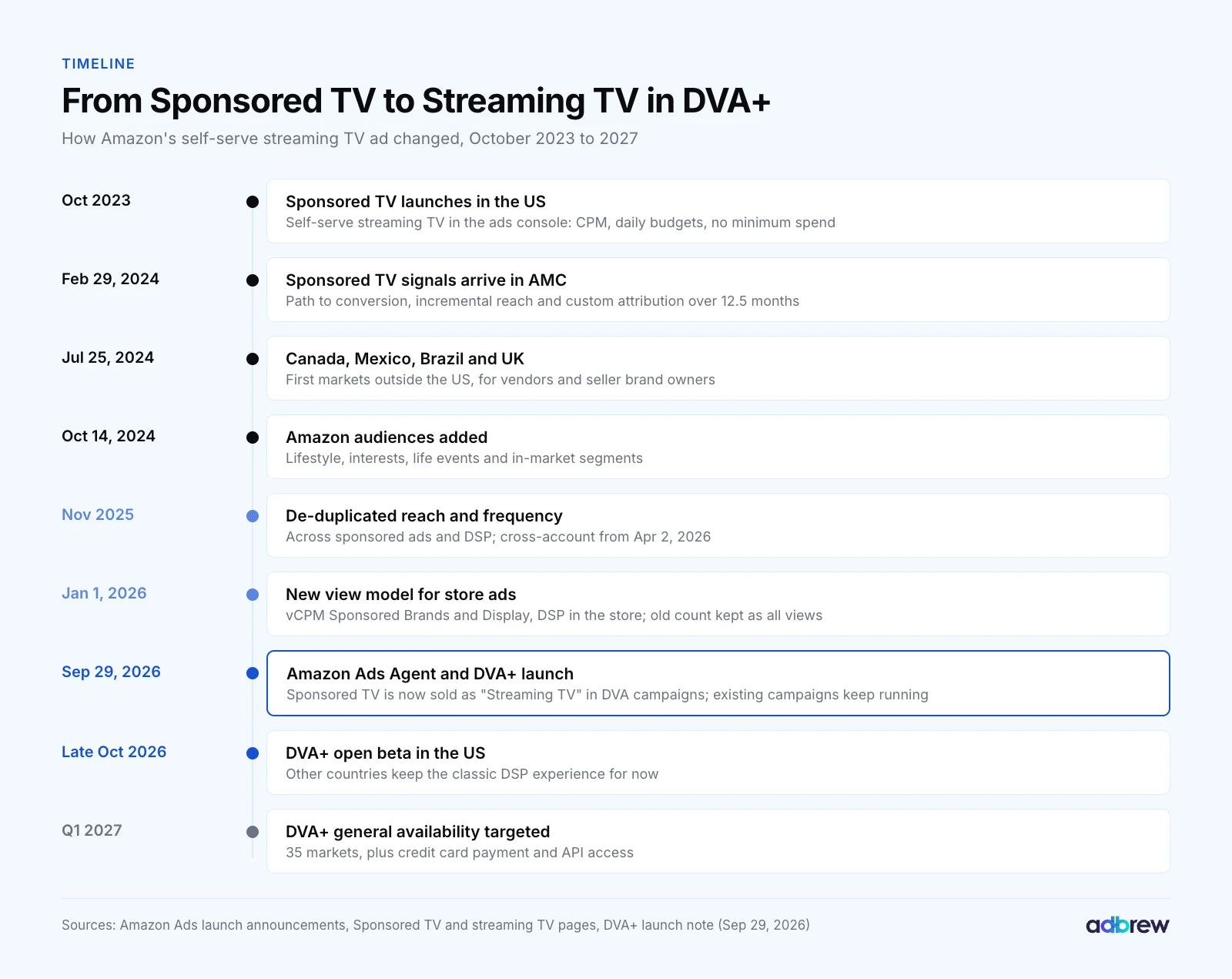
The bigger change came at unBoxed on September 29, 2026. Amazon renamed its unified platform Amazon Ads Agent, and DSP campaigns became Display, Video and Audio (DVA) campaigns.
DVA+ is the simplified version. Amazon calls it "a unified campaign type bringing together what was previously created through Amazon DSP, Sponsored Display, and Sponsored TV." Our guide to Amazon DSP ad types covers every format DVA+ can buy.
The rollout is staged. Amazon's DVA+ launch note says DVA+ was in extended closed beta in the US, with open beta from late October 2026, international expansion through Q4 2026 and general availability in 35 markets targeted for Q1 2027.
Three details from that note matter to former Sponsored TV buyers:
Access: Sponsored ads advertisers get DVA+ quick setup. Advanced settings can be requested through an Amazon Ads account manager.
Payment: Payment is invoice-only during the closed beta, with credit card support planned for Q1 2027.
Audio: Audio joins DVA+ after launch, in Q4 2026.
What If You Advertise Outside the US?
DVA+ is US only for now. Amazon's DVA+ page lists 21 countries, including Canada, Mexico, the UK, Germany, India, Japan and Australia, where advertisers who used Amazon DSP "will continue to see the Amazon DSP experience."
Self-service streaming TV, the old Sponsored TV, launched outside the US in Canada, Mexico, Brazil and the UK on July 25, 2024. Amazon's streaming TV guide still lists exactly those markets plus the US, and Amazon has not published a separate cutover date for them.
In practice: if you ran Sponsored TV in the UK or Canada, keep running it where you find it, and expect DVA+ to arrive as Amazon expands it through 2027.
How Buying Streaming TV Works Now
There are three ways to buy Amazon streaming TV in late 2026. The right one depends on your market, your team and how much control you need.
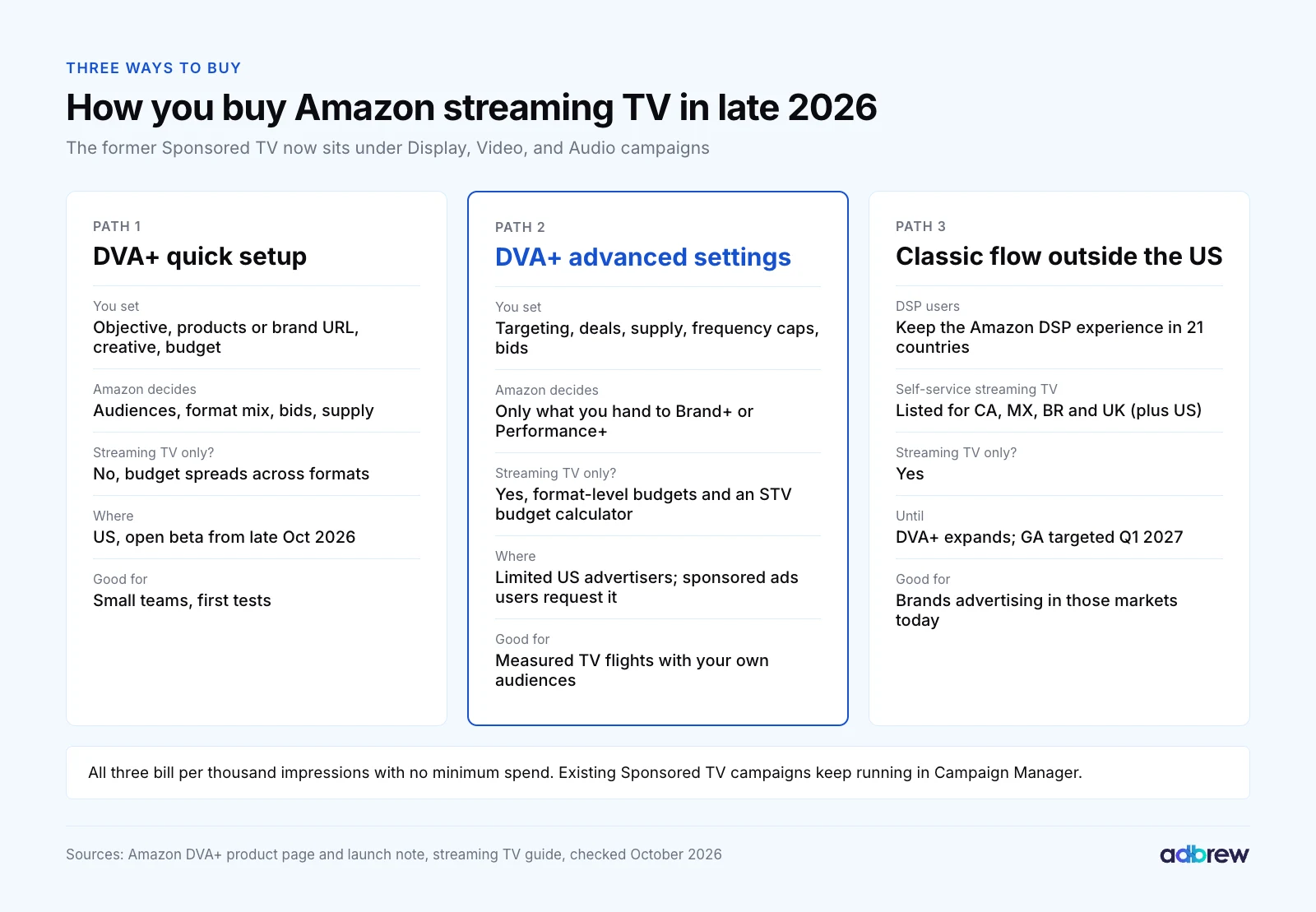
1. DVA+ Quick Setup
Quick setup takes four steps: pick an objective (sales, traffic, awareness, leads and more), add products or a brand URL, review AI-generated creative and set a budget. Amazon's AI then handles targeting, inventory, format mix, bidding and optimization.
This is the closest thing to the old Sponsored TV experience. The catch is that you no longer choose streaming TV alone; DVA+ spreads the budget across streaming TV, online video and display unless you open advanced settings.
2. DVA+ Advanced Settings
Advanced settings return the programmatic controls: manual targeting, lookalikes, retargeting and suppression, deals, publisher lists, frequency caps and format-level budgets.
Amazon's launch table also lists a budget calculator "for STV only", meaning streaming TV. If you want a streaming-TV-only campaign with your own audiences, this is where you build it.
3. The Classic Flow Outside the US
Outside the US, DSP users keep the Amazon DSP experience with its renamed objects: an order is a campaign, a line item is an ad group and a creative is an ad. Our guide to creating an Amazon DSP campaign walks through it.
Self-service streaming TV in Canada, Mexico, Brazil and the UK still follows the Sponsored TV pattern Amazon's guide describes: create a streaming TV campaign, name it, set a daily budget, choose a landing page and audiences, upload a video.
How Much Do Amazon Sponsored TV Ads Cost?
Streaming TV is billed per thousand impressions with no minimum spend. Amazon's guide says it again: "All streaming TV campaigns are billed on a CPM basis with no minimum budget required."
There is a recommended figure, though. Amazon's streaming TV page says "self-service packages have a $10K recommended campaign minimum, and managed-service packages have a $50K campaign minimum."
Read that $10,000 as advice, not a rule. Nothing stops a $3,000 campaign from launching, but it buys too few impressions to read a branded search lift with any confidence.
Amazon's own starting points for smaller brands:
Budget: Start at $150 a day to test, then scale on results.
Audiences: Start with three to five.
Bids: $10 to $15 CPM for broad audiences, $20 to $25 for audiences closely matched to the product.
Those starting numbers don't quite agree with the $10,000 recommendation. At $150 a day, a 30-day flight costs $4,500.
We treat $150 a day as a learning budget for creative and audiences, and the $10,000 figure as the floor for a flight you intend to measure.
Worked Example: From CPM to Reach and Frequency
Every streaming TV plan starts with the same arithmetic: budget divided by CPM gives impressions, and impressions divided by frequency gives reach. Here is a four-week flight with illustrative numbers.
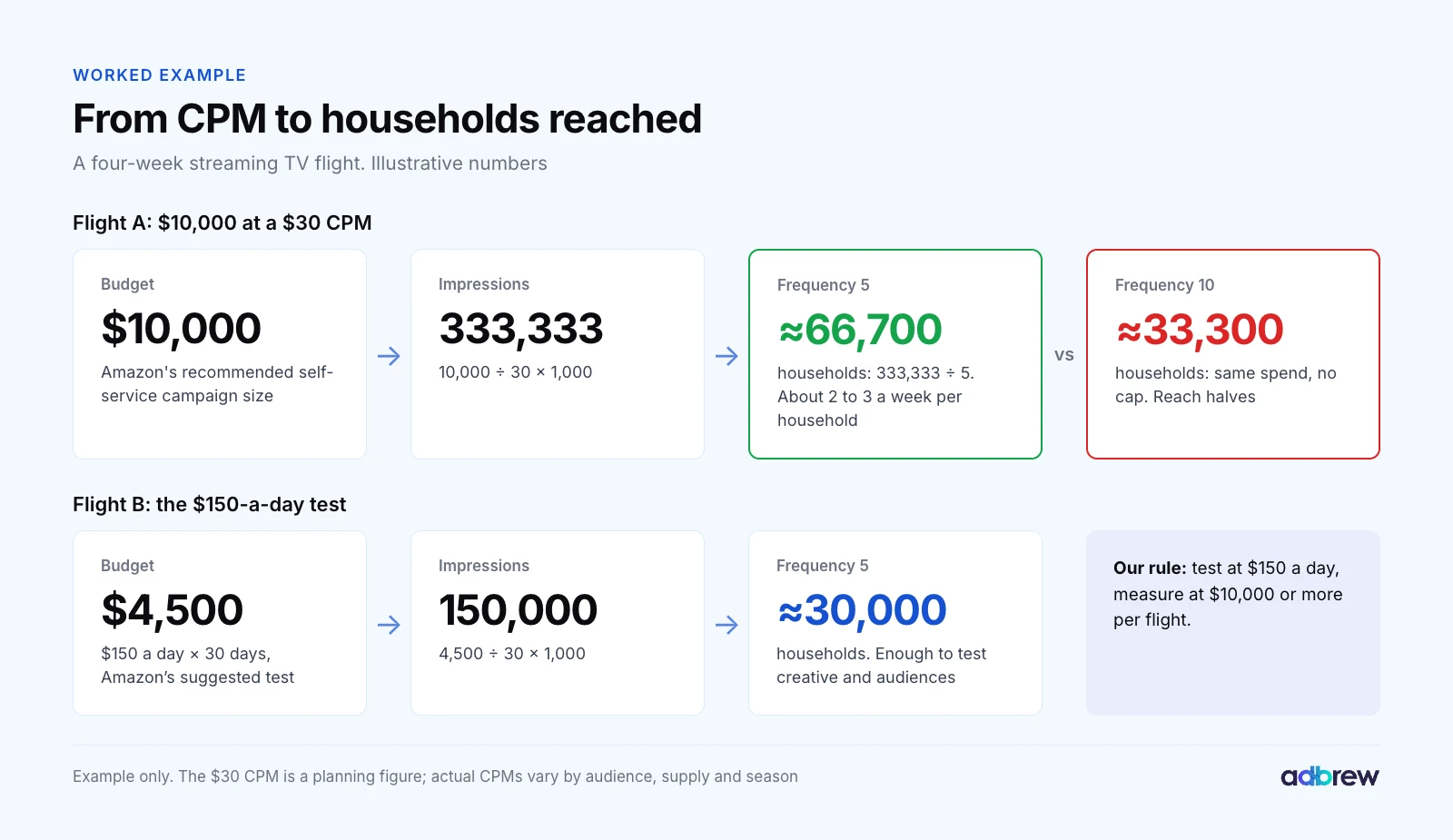
Impressions. $10,000 at a $30 CPM buys 10,000 ÷ 30 × 1,000 = 333,333 impressions.
Reach at a healthy frequency. At an average of 5 impressions per household over four weeks, that is 333,333 ÷ 5 ≈ 66,700 households.
Reach without a cap. If the same budget piles up at 10 per household, reach halves to about 33,300 households.
The test budget. $4,500 at the same CPM buys 150,000 impressions, or about 30,000 households at a frequency of 5.
The lesson is in step 3. Frequency is where streaming TV budgets leak, and Amazon's Sponsored TV setup guide has no frequency cap step.
In DVA+ advanced settings or the DSP, we start streaming TV at two to three impressions per household per week, the same starting point as our frequency capping guide. Over four weeks that keeps the average near five.
The $30 CPM is our planning number, not Amazon's. Actual CPMs depend on audience, supply and season, so replace it with your own after the first week.
Targeting: What Sponsored TV Offered and What You Get Now
Sponsored TV targeting was deliberately simple. Amazon's guide describes two types: content interests (viewers likely to watch, say, documentaries or music videos) and in-market categories (viewers shopping categories like built-in dishwashers).
Each ad group needed at least one segment and no more than 20, with lookback windows of up to 30 days. Every segment carried its own CPM bid, which is why the old console showed a bid column next to each audience.
On October 14, 2024, Amazon added standard Amazon audiences to Sponsored TV: lifestyle, interests, life events and in-market segments built from shopping and streaming signals.

In DVA+ quick setup, audience targeting is "AI-managed automatically." Advanced settings and the DSP open the full library, which Amazon's streaming TV page puts at more than 20,000 first-party audiences.
Two targeting moves make the most difference in our accounts. Both need advanced settings or the DSP:
Suppress recent buyers. A household that bought last week does not need your TV spot. Exclude purchasers over 30 to 90 days, depending on your repurchase cycle.
Feed AMC audiences in. Lookalikes of your best customers, built in Amazon Marketing Cloud, usually beat a generic in-market segment on new-to-brand rate.
Our guide to Amazon DSP targeting covers each audience type in depth.
Landing Pages and Retail Awareness
A Sponsored TV ad linked to one product detail page or to your Brand Store, and Amazon described the format as retail aware. Its checklist still says to "select an ASIN that is in-stock and aligns with the video you're using."
The landing page shapes the interaction. With a detail page, a viewer can press the remote to add to cart; with a Brand Store, the QR code scans through to the store and a remote click emails the viewer a link.
Creative Specs for Amazon Streaming TV Ads
Streaming TV ads use the same specs whether you buy them self-service or through DVA. These come from Amazon's streaming TV and Prime Video ad specs, checked in October 2026.

Spec | Requirement |
|---|---|
Aspect ratio and size | 16:9, minimum 1920x1080 |
Maximum file size | 500 MB |
Minimum video bitrate | 15 mbps for Prime Video, 8 mbps for Twitch, Fire TV Channels and third-party apps |
Frame rate | 23.976 fps recommended, constant |
Audio | AAC, at least 192 kbps, 44.1 or 48 kHz, at least two channels |
US lengths | Prime Video 15, 30, 45, 60 sec; Twitch 15 or 30; Fire TV Channels up to 90 |
Calls to action | No clickable-looking buttons on non-interactive ads |
The 2024 version of this post listed a 4 mbps minimum bitrate and 15 or 30-second spots for Sponsored TV. Submit at 15 mbps or more today, or your ad cannot serve on Prime Video, the inventory most brands want.
Amazon's creative guidance is worth following to the letter, because moderation rejects ads that ignore it:
Show the logo or product in the first three seconds, and keep a logo in a corner, top left or lower left, within the safe area.
End on a card with the brand name and an "available at Amazon" badge.
Keep on-screen text short and let the voice-over carry the message.
Substantiate every claim ("clinically proven", "#1") or remove it.
Interactivity is the main reason to buy streaming TV on Amazon rather than elsewhere. Amazon reports 36% more orders for streaming TV ads with interactivity than without, on its own US data.
No video yet? DVA+ quick setup can generate streaming TV creative from your product listings, and Amazon sells production services. We still brief a proper 15 or 30-second spot for hero products, because generated creative looks generic on a 65-inch screen.
How to Measure Amazon Streaming TV Ads
The fastest way to kill a good streaming TV campaign is to judge it on the same ROAS as Sponsored Brands. It will lose every time, because its job happens before the search.
Amazon's guide even suggests putting "STV" in the campaign name so you can exclude it from ROAS views. We do exactly that.

These are the metrics we read, in order:
Impressions, reach and frequency. Did the flight reach enough households at a sane frequency? Since November 2025, Amazon's dynamic reach and frequency reporting de-duplicates reach across sponsored ads and DSP campaigns, extended across accounts on April 2, 2026.
Branded searches. Amazon reports searches for your brand after ad exposure. This is the single best early signal that TV worked.
Detail page views and new-to-brand. Track new-to-brand detail page views and purchases; our new-to-brand metrics guide explains the 12-month rule behind them.
Long-term sales. Amazon's long-term sales metric estimates the 12-month value of the new-to-brand detail page views, branded searches and add-to-carts an ad drives.
What the January 2026 View Model Means for Streaming TV
On January 1, 2026, Amazon moved view attribution to a new model for vCPM Sponsored Brands, vCPM Sponsored Display and DSP ads that serve in the Amazon store. The old count survives as "all views" metrics, such as Purchases (all views).
Streaming TV isn't on that list, because it doesn't serve in the store. But the display and video lines you compare it with now report fewer view-through conversions by default, so check that every report in a comparison uses the same view metric.
Prove It in AMC
Sponsored TV signals have been in Amazon Marketing Cloud since February 29, 2024, with up to 12.5 months of history. Amazon names three uses: path to conversion, incremental reach and custom attribution.
The query we run first compares shoppers exposed to streaming TV and then to Sponsored Products with those who only saw Sponsored Products. Amazon's guide cites its own 2024 data: journeys with a streaming TV ad and other sponsored ads had a 58% better new-to-brand conversion rate and a 110% better purchase rate than sponsored ads alone.
Treat those as Amazon's figures on Amazon's measurement. Your own AMC path-to-conversion numbers are the ones to show a CFO, and our Amazon DSP reports guide lists the standard reports to pull first.
Who Should Use Amazon Streaming TV Ads?
Streaming TV is an awareness channel. It works when there is already something at the bottom of the funnel to catch the demand it creates.

It is a good fit when:
your hero products are in stock, with ratings that convert at first sight,
Sponsored Products and Sponsored Brands already capture your branded and category searches,
your product is easier to show than to describe, such as kitchen, home, toys, beauty or fitness,
you can fund a measurable flight, around $10,000, and wait four to eight weeks for a read.
Wait if your account is still fighting for profitability on search, or if the product is a low-consideration commodity where shoppers buy the cheapest listing. Fix the bottom of the funnel first; our full-funnel strategy guide covers the order we build it in.
Brands that don't sell on Amazon can buy streaming TV through DVA too, with link-out goals measured by the Amazon Ads pixel. Our guide to using Amazon DSP as a non-Amazon seller covers that setup.
Streaming TV, Prime Video Ads and Sponsored Display
People often confuse three products here. Streaming TV is the format and the inventory; Prime Video ads are streaming TV ads that run on Prime Video specifically.
Sponsored Display, now called display ads in Amazon Ads Agent, is a different job: banners and video on Amazon and the open web, mostly for remarketing. Our Amazon DSP vs Sponsored Display comparison explains where each fits.
Mistakes We See With Amazon Streaming TV Ads
Judging it on 14-day ROAS. Streaming TV loses that contest to retargeting every time. Use reach, branded searches and new-to-brand.
Uncapped frequency. In our worked example, doubling frequency halves reach on the same budget.
Running a "Shop now" button on a non-interactive spot. Amazon's specs prohibit clickable-looking CTAs on non-interactive ads.
Sending TV traffic to an out-of-stock ASIN. You pay to build demand for a competitor's listing.
Low-bitrate files. Anything under 15 mbps can't serve on Prime Video.
Turning it off after two weeks. Branded search lift takes a few weeks to show. Decide on a flight length before launch and keep to it.
Handing everything to DVA+ quick setup. Run it beside a streaming TV campaign you control, and compare new-to-brand customers for the period.
How We Run Streaming TV in Adbrew
Everything above can be done in Amazon Ads Agent directly. The hard part is connecting a TV flight to what happens in search and retail afterwards, across several brands, without a week of spreadsheet work.
Adbrew is an agentic retail media management platform for Amazon and Walmart, and streaming TV sits next to Sponsored Ads, AMC and Walmart Connect inside it:
Streaming TV through Adbrew's DSP seat. Run Amazon DSP through Adbrew, including streaming TV and Prime Video, with no minimum spend, or connect your existing DSP account. DVA+ campaigns themselves are built in Amazon Ads Agent.
Automation you can read. Rules you set for bids, budgets, audiences and frequency caps, with your own thresholds, and every change logged.
AMC without SQL. Pre-built path-to-conversion and new-to-brand reports, and custom audiences of TV-exposed shoppers you can push into DSP and Sponsored Ads.
[Adbrew Intelligence](https://adbrew.io/adbrew-intelligence). Ask "how did branded search and new-to-brand change in the four weeks after our streaming TV flight?" and an agent builds the report from your data.
Brands on Adbrew cut ACOS by 46% on average, and more than 5,000 brands, agencies and aggregators use it.
Put Streaming TV Where It Can Be Measured
Sponsored TV made streaming TV affordable for brands of any size, and Streaming TV in DVA+ keeps that promise with more automation and more controls. What hasn't changed is the work around it: retail readiness first, frequency under control, and a measurement plan written before launch.
Want to see streaming TV, AMC and Sponsored Ads reported side by side on your own account? Book a demo with our team and we'll plan your first flight with you.
Frequently Asked Questions
What are Amazon Sponsored TV ads?
Amazon Sponsored TV ads were self-serve streaming TV ads bought in the Amazon Ads console, launched in October 2023. Brands ran full-screen, non-skippable video ads on Prime Video, Twitch, Fire TV and partner apps, with CPM bids per audience, daily budgets and no minimum spend. In 2026 Amazon renamed the product "Streaming TV".
Is Amazon Sponsored TV still available?
Yes, under a new name. Amazon says advertisers can continue to access Sponsored TV as "Streaming TV" within Display, Video, and Audio campaigns in Amazon Ads Agent. In the US, DVA+ rolls out from late October 2026; elsewhere, Amazon targets general availability in 35 markets for Q1 2027.
What happens to existing Sponsored TV campaigns?
Existing Sponsored TV campaigns continue to run uninterrupted, according to Amazon's Sponsored TV page. Advertisers find and manage them through Campaign Manager in Amazon Ads Agent, and nothing needs to be rebuilt for them to keep serving.
Which type of advertiser brands can use Sponsored TV?
Sponsored TV was open to sellers enrolled in Amazon Brand Registry and to vendors. Amazon's streaming TV page now lists Brand Registry sellers, vendors (including book vendors and publishers), agencies, technology providers and brands that don't sell on Amazon in the US, all with no minimum spend requirement.
How much do Amazon Sponsored TV ads cost?
Amazon streaming TV ads are billed per thousand impressions with no minimum spend. Amazon recommends $10,000 per self-service campaign, while managed service has a $50,000 campaign minimum. Amazon's guide suggests small businesses test at $150 a day, with CPM bids of $10 to $25 depending on how targeted the audience is.
Is Sponsored TV available outside the US?
Sponsored TV launched in Canada, Mexico, Brazil and the UK on July 25, 2024, and Amazon's streaming TV guide still lists those markets plus the US for self-service. DVA+ is US only for now, and DSP users in 21 other countries keep the existing Amazon DSP experience until it expands.
What is the difference between Sponsored TV and Amazon DSP streaming TV?
Sponsored TV was a self-serve sponsored ad with simple targeting, a bid per audience and daily budgets. Streaming TV through Amazon DSP, now Display, Video, and Audio campaigns, adds deals, frequency caps, AMC audiences, retargeting and suppression, and is open to brands that don't sell on Amazon.
How do you measure Amazon streaming TV ads?
Measure Amazon streaming TV ads on reach, frequency, branded searches, detail page views and new-to-brand customers, then long-term sales. Use Amazon Marketing Cloud path-to-conversion queries to compare shoppers who saw streaming TV and then searched with those who only saw search ads.